




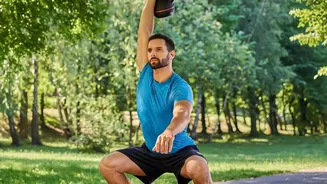
The Power of Your Own Body
Before we jump into the exercises, it’s important to understand why bodyweight training is so powerful. It’s a form of resistance training that builds real-world, functional strength by mimicking everyday movements like pushing, pulling, and squatting.
These exercises often engage multiple muscle groups at once, improving your balance, flexibility, and core stability. Research has shown that bodyweight routines can lead to significant improvements in aerobic capacity and muscle endurance. Best of all, they are incredibly convenient and cost nothing, removing two of the biggest barriers to consistent exercise.
Lower Body: Squats and Lunges
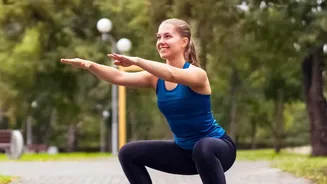
The squat is one of the most fundamental human movements and a powerhouse for building lower body strength. To perform a bodyweight squat, stand with your feet shoulder-width apart and lower your hips as if you are sitting in a chair, keeping your chest up and back straight. Go as low as you can comfortably, then push through your heels to return to the start. Lunges are another fantastic exercise for your legs and glutes. Step one foot forward and lower your hips until both knees are bent at a 90-degree angle. Push off the front foot to return to the starting position and repeat on the other side. Both exercises require minimal space and are incredibly effective at targeting the largest muscles in your body.
Upper Body: Push-Ups and Planks
The push-up is a classic for a reason: it builds strength in the chest, shoulders, and triceps while also engaging your core. Start in a high plank position with your hands slightly wider than your shoulders. Lower your body until your chest is close to the floor, keeping your body in a straight line from head to heels, then push back up. If a full push-up is too challenging, you can modify it by placing your knees on the floor. The plank is an isometric exercise that works your entire core. Hold the top position of a push-up, either on your hands or forearms, ensuring your back is flat and your abs are engaged. Hold for 30-60 seconds to build incredible core stability.
Cardio Boost: On-The-Spot Action
You don't need to run or have a machine to get your heart rate up. High Knees, where you run in place while bringing your knees up towards your chest, are an excellent cardio drill. Jumping Jacks are another simple yet effective option that elevates your heart rate while working your entire body. For a more intense challenge, try Mountain Climbers. From a plank position, alternate bringing one knee towards your chest at a time, as if you are running horizontally. These exercises can be done in a very small footprint and are perfect for boosting your cardiovascular endurance.
Core Focus: Crunches and Leg Raises
A strong core is the foundation of a healthy body, supporting good posture and preventing injury. The basic crunch targets your upper abdominals. Lie on your back with your knees bent, feet flat on the floor, and hands behind your head. Lift your head and shoulders off the floor, focusing on using your ab muscles. For your lower abs, leg raises are ideal. Lie on your back with your legs straight. Slowly lift your legs towards the ceiling until they are perpendicular to the floor, then slowly lower them back down without letting them touch the ground. These moves require only enough space to lie down.
Putting It All Together: A Sample Circuit
The key to a great workout is structure. A circuit is a fantastic way to combine these exercises for a full-body routine. Try performing each exercise for 45 seconds, followed by 15 seconds of rest before moving to the next. Once you complete all the exercises, that's one circuit. Rest for one to two minutes, and then repeat the entire circuit 2-3 more times. A sample circuit could look like this: Squats, Push-Ups, Lunges (alternating legs), Plank, and High Knees. This format keeps your heart rate elevated, allowing you to get both strength and cardio benefits in a short amount of time.