






Why Space? The Microgravity Advantage
On Earth, gravity is an invisible but relentless force that affects everything, including the development of delicate biological structures. When scientists try to grow protein crystals for pharmaceutical research, gravity causes convection and sedimentation.
These forces can introduce imperfections and limit the size and uniformity of the crystals. In the near-weightlessness of low-Earth orbit, these issues vanish. Without gravity pulling denser materials down, protein molecules can assemble themselves more slowly and orderly. This results in larger, more uniform, and structurally perfect crystals. For drug developers, a perfect crystal is a perfect blueprint. It allows them to use X-ray crystallography to map the protein's three-dimensional structure with unprecedented detail, revealing exactly how a drug might bind to it.
From Lab Curiosity to Production Line
For decades, growing crystals in space was a niche research activity, mostly conducted on the International Space Station (ISS) by national space agencies. These experiments proved the principle, showing that space-grown crystals could lead to better drug designs for everything from muscular dystrophy to cancer. One key experiment with Merck's cancer drug Keytruda showed that microgravity allowed for the creation of a stable crystal form that could be delivered via a simple injection, a huge improvement over the Earth-made version which requires IV infusion. Now, the industry is shifting from one-off experiments to scalable production. This transition is driven by a new generation of commercial space companies aiming to build and operate their own orbiting factories, moving beyond research and into manufacturing.
The Pioneers of Orbital Pharma
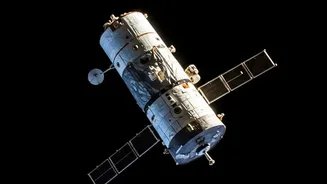
Several companies are at the forefront of this new industry. Redwire is a key player, developing hardware like its Pharmaceutical In-Space Laboratory (PIL-BOX) and partnering with major pharmaceutical companies like Eli Lilly and Company and Bristol Myers Squibb. They are focused on moving beyond structural analysis to using space to create better crystal forms that improve drug manufacturing, stability, and delivery on Earth. Varda Space Industries is taking a different approach, launching its own unmanned capsules that serve as miniature, automated drug factories. After crystallizing materials in orbit, the capsule re-enters the atmosphere and returns the finished product. Meanwhile, companies like Axiom Space are building the infrastructure of tomorrow, constructing the first commercial space stations that will host dedicated research and manufacturing facilities for a host of industries, including biotechnology.
The Earthly Payoff: Better Drugs and Treatments
The ultimate goal of this orbital industry is to create tangible benefits for patients on Earth. Higher-purity crystals can lead to drugs that are more stable, have a longer shelf-life, and can be administered more conveniently, for instance, as an injection instead of an intravenous drip. Understanding a protein's exact structure helps researchers design more targeted and effective drugs with fewer side effects. Some companies have even demonstrated that crystals grown in space can be used as 'seeds' to replicate their superior structure in terrestrial labs, creating a scalable manufacturing model without needing to produce every dose in orbit. This new paradigm could accelerate drug development for a wide range of conditions, including various cancers, Alzheimer's, and cardiovascular disease.
Hurdles in the Final Frontier
Despite the immense potential, the path to large-scale orbital manufacturing is not without challenges. The cost of launching materials to and from space, while decreasing, remains a significant financial barrier. The process involves complex logistics, from launching the raw materials to safely returning the finished, delicate crystals through the rigours of atmospheric re-entry. Furthermore, any drug intended for human use must navigate the stringent approval processes of regulatory bodies. Finally, there's the stability of the drugs themselves; the space environment involves radiation and other factors that could affect a medication's shelf-life and efficacy, presenting ongoing challenges for formulation and packaging.