





What Are 'Roasted Worlds'?
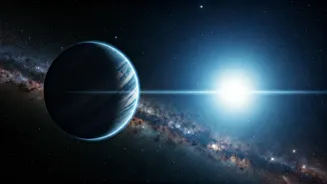
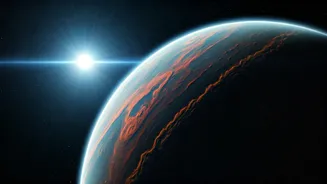
Imagine a planet several times the size of Jupiter, orbiting its star so closely that its year lasts only a few Earth days. The proximity results in surface temperatures hot enough to melt rock, earning them the dramatic nickname 'roasted worlds'. Scientifically,
they are known as hot Jupiters. These gas giants were among the first exoplanets to be discovered because their large size and tight orbits cause a significant and easily detectable wobble in their parent stars. The first, 51 Pegasi b, discovered in 1995, stunned the astronomical community with its four-day orbit. Since then, hundreds more have been catalogued, each a blazing inferno with a story to tell. Their intense heat causes their atmospheres to puff up, making them much larger and less dense than would be expected for their mass.
An Atmospheric Fingerprint
The scientific magic of roasted worlds happens when they pass in front of their star from our point of view, an event called a transit. As the starlight shines through the planet's bloated atmosphere, the gases and chemicals present absorb specific wavelengths of light. This creates a unique chemical fingerprint in the light that reaches our telescopes. By analysing this filtered light—a technique called transmission spectroscopy—astronomers can determine exactly what the alien atmosphere is made of. This process is like holding a prism up to starlight that has passed through another world. The resulting spectrum reveals the presence of molecules like water vapour, carbon dioxide, methane, and even more exotic compounds.
The Power of the Webb Telescope
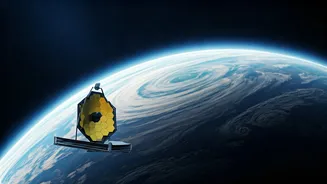
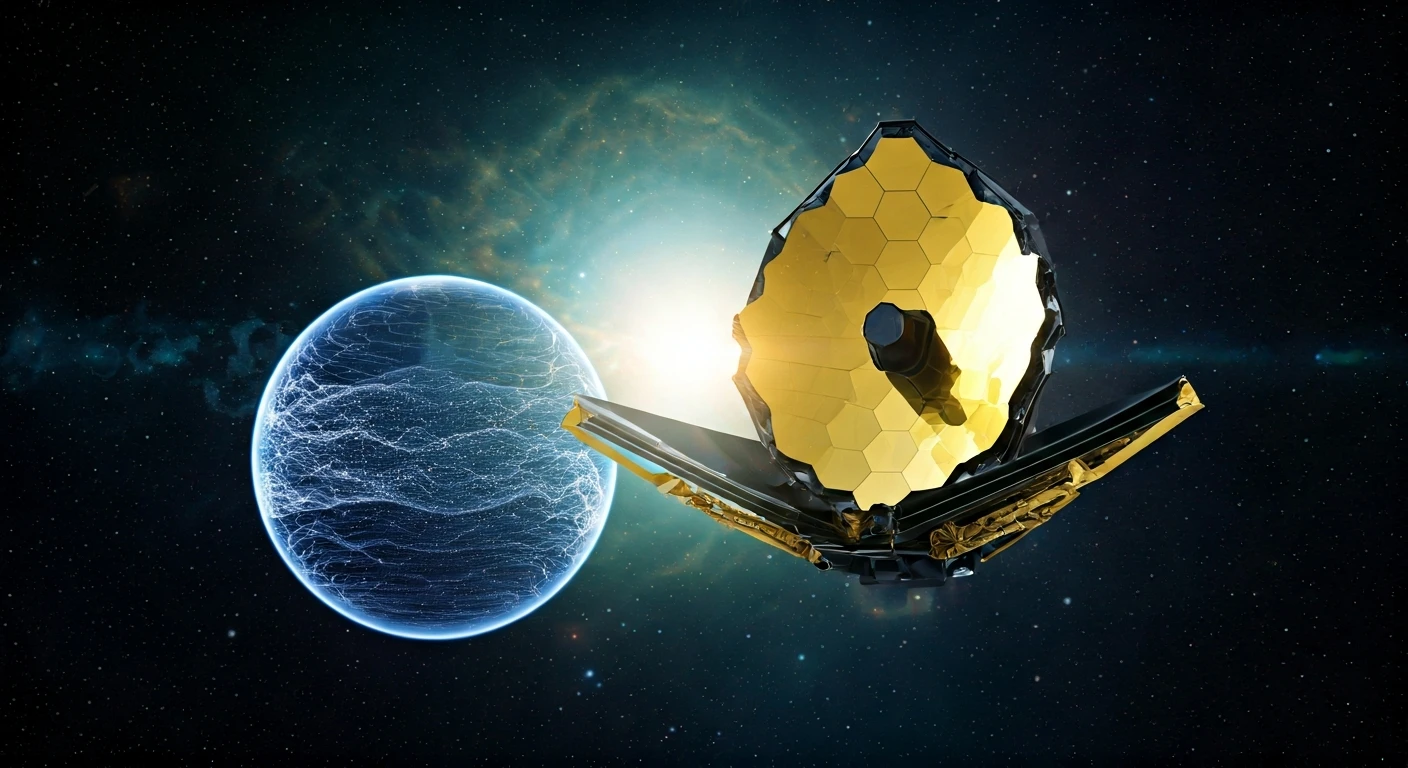
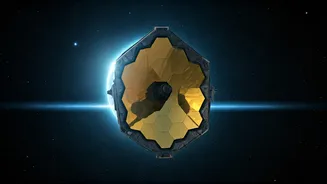
The James Webb Space Telescope (JWST) has been a game-changer in this field. Its powerful infrared instruments are perfectly tuned to detect the faint chemical signatures in the atmospheres of these distant worlds. Early in its mission, JWST provided the first definitive evidence of carbon dioxide in an exoplanet's atmosphere, on the hot gas giant WASP-39 b. More recently, within the last month, JWST observed the exoplanet HD 80606 b, a 'roasted' world on a highly eccentric orbit. As it swung close to its star, its temperature skyrocketed by over 600 degrees Celsius, allowing scientists to study how its atmospheric chemistry changes in real-time under extreme heating. Just this week, on July 1, 2026, results from JWST provided the first atmospheric measurements of a planet orbiting a white dwarf, the dead remnant of a star, revealing a world warmer than expected with an atmosphere containing methane.
From Hellscape to Rosetta Stone
While these planets are utterly inhospitable, they act as crucial Rosetta Stones for planetary science. Because their atmospheres are so hot and expanded, they are far easier to study than the thin atmospheres of smaller, cooler, rocky planets. The techniques and models developed by analysing these extreme worlds are vital for the ultimate goal: searching for signs of life on Earth-like planets. By understanding how planetary atmospheres form and evolve under a wide range of conditions, scientists can better interpret the data from potentially habitable worlds. For example, recent studies using JWST have shown that clouds and weather patterns on these hot Jupiters are not uniform, a finding that will be critical for accurately reading the atmospheres of other planets.
A Stepping Stone to Finding Another Earth
Studying roasted worlds is not about finding alien life on them. It is about sharpening our tools and honing our understanding for when we point our telescopes at a world that could be a second Earth. These hot Jupiters challenge our theories of planetary formation; their existence was not predicted by models based on our own solar system. Some theories suggest they form far out and migrate violently inward, ejecting other planets in the process. By untangling the history of these bizarre systems, scientists piece together the grand puzzle of how planetary systems, including our own, come to be. Every molecule detected in the atmosphere of a world being roasted by its star is another clue, bringing us one step closer to answering the profound question of whether we are alone in the universe.