


Sailing on Sunshine
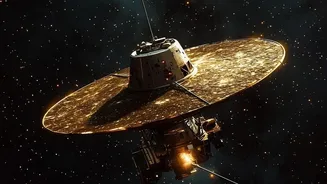
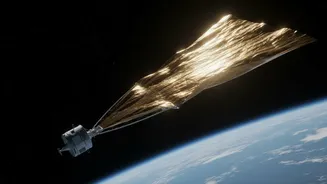
A solar sail is a remarkable method of spacecraft propulsion that uses the gentle, continuous pressure from sunlight to move through space. Much like a sailboat on the ocean uses wind to push it forward, a solar sail uses the momentum of photons—particles
of light—radiating from the sun. Although photons have no mass, they have momentum. When they bounce off a large, reflective, and incredibly thin sail, they transfer that momentum, giving the spacecraft a tiny but constant push. While the initial force is subtle, barely equivalent to the weight of a feather on your hand, it is relentless. Over months and years, this continuous acceleration can propel a craft to immense speeds, far beyond what could be achieved with a limited supply of conventional chemical rocket fuel.
Recent Breakthroughs in Sail Technology
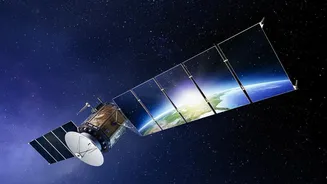
The promise of solar sailing has been understood for decades, but recent advancements are finally making it a practical solution for space missions. NASA's Advanced Composite Solar Sail System (ACS3), which launched in April 2024, recently achieved a major milestone by successfully deploying its sail in Earth orbit. This test is crucial because it validates new lightweight composite booms made of carbon fiber, which are much stiffer and lighter than the metal booms used in previous designs. These advanced booms are the key to building much larger sails in the future. The ACS3 sail is about the size of a small apartment, but the technology it proves could enable sails as large as a basketball court or even half a soccer field. Successful missions like The Planetary Society's LightSail 2, which used its sail to change its orbit between 2019 and 2022, paved the way for these next-generation systems.
Why This Is a Game-Changer
The biggest advantage of solar sailing is that it eliminates the need for propellant. A traditional spacecraft is fundamentally limited by the amount of fuel it can carry. Once the fuel runs out, its mission is effectively over. Solar sails, on the other hand, have a virtually limitless source of propulsion as long as the sun shines. This opens up a whole new realm of possibilities for long-duration missions. It allows for low-cost operations and the ability to reach unique destinations in the solar system that are difficult or impossible to access with chemical rockets. Missions could loiter at interesting points, like hovering over the poles of the Sun, or travel to the far reaches of the solar system for asteroid reconnaissance or space weather monitoring. By removing the heavy propulsion systems, spacecraft can be lighter, cheaper, and dedicated to carrying more scientific instruments.
The Future of Interplanetary Travel
The successful testing of technologies like ACS3 marks a turning point. We are moving from small-scale demonstrations to engineering systems for ambitious scientific journeys. Future solar sail missions are already being planned that are significantly larger and more capable. For example, a planned NASA mission supported by Opterus will feature a sail 20 times the area of ACS3, roughly the size of a hockey rink, with delivery planned for 2028. These larger sails will be able to carry more sophisticated payloads and travel faster, potentially enabling missions to the outer planets in record time. There is even potential for solar sails to become our best option for interstellar travel, pushing a probe toward a nearby star system over many decades. By perfecting the art of sailing on light, we are not just finding a new way to get around the solar system; we are expanding the very boundaries of what is possible in our quest to explore the cosmos.