


Putting the Numbers in Perspective
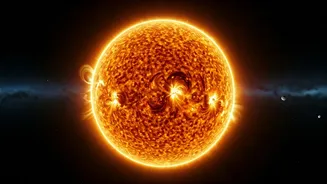
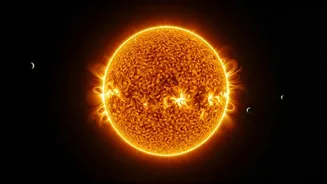
When we say the Sun dominates the solar system, it’s not an exaggeration. The most precise measurements show that our star accounts for a staggering 99.86% of all the matter in our cosmic neighbourhood. [1, 3, 10] That means all eight planets, including
the gas giants Jupiter and Saturn, plus all the dwarf planets, moons, asteroids, and comets, collectively make up a mere 0.14% of the system's total mass. [3, 7] To put it another way, everything that is not the Sun is just a tiny fraction of the cosmic rounding error. Earth itself accounts for only about 0.0003% of the solar system's mass. [3] This incredible disparity in mass is the single most important factor defining our solar system.
The King of the Leftovers
Of the sliver of mass that isn't the Sun, one planet reigns supreme: Jupiter. The gas giant is so large that it contains about 70% of the planetary mass all by itself. [3, 8] In fact, Jupiter is more than twice as massive as all the other planets combined. After Jupiter, Saturn accounts for most of the rest, at about 21% of the non-solar mass. [11] The two ice giants, Uranus and Neptune, make up a significant portion of the remainder. [10] All the rocky inner planets—Mercury, Venus, Earth, and Mars—along with every asteroid and comet, represent a tiny fraction of what was left over after the giants formed. [10, 11] For all practical purposes, our solar system can be thought of as the Sun, Jupiter, and a sprinkle of cosmic dust. [14]
The Gravity of the Situation
This extreme mass concentration is the reason our solar system has its familiar structure. The Sun’s immense mass generates a powerful gravitational field that dictates the orbits of everything around it. [5, 17] It is the anchor that holds every planet in a stable, predictable path. Without the Sun’s gravitational dominance, the planets would not be held in their orbits; they would simply drift off into interstellar space. [5, 9] This gravitational pull was established early in the solar system's history, around 4.6 billion years ago, when a vast cloud of gas and dust collapsed. [1, 6] Most of this material fell to the centre to form the Sun, while the rest flattened into a spinning disk from which the planets were born. [1]
A Wobble in the System
While the Sun holds the planets in place, they aren't entirely without influence. Jupiter is so massive that it doesn't technically orbit the exact centre of the Sun. Instead, both the Sun and Jupiter orbit a common centre of mass, known as the barycenter, that lies just outside the Sun's surface. [3] This causes our star to have a slight but detectable "wobble" as Jupiter makes its journey around it. This very principle—detecting the wobble of a distant star—is one of the key methods astronomers use to find exoplanets orbiting other stars. [14] Even though the planets are insignificant in terms of mass compared to the Sun, their gravitational tug is still measurable across the vast distances of space.