



Drowning in a Sea of Stars
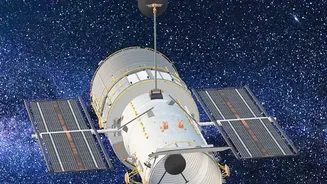
Telescopes like Hubble and the James Webb Space Telescope, along with sky-survey missions like Kepler and TESS, are technological marvels. They capture staggering amounts of information, revealing the cosmos in breathtaking detail. But this success presents
a huge challenge: data overload. These instruments generate petabytes of data—far too much for scientists to sift through manually. Finding a single exoplanet or a rare cosmic event in these vast archives can be like finding a needle in a cosmic haystack. This is where artificial intelligence is becoming an indispensable partner for astronomers.
AI: The Ultimate Research Assistant
Artificial intelligence, specifically machine learning, excels at pattern recognition. Scientists can train AI models on known data—for example, what the light from a star looks like when a planet passes in front of it—and then unleash the AI on new, unanalyzed datasets. These algorithms can process information thousands of times faster than a human, spotting subtle signals that might otherwise be missed. NASA's ExoMiner AI, for instance, learned to distinguish real exoplanets from false positives by analyzing data from the Kepler mission. It successfully identified 301 new planets that had been overlooked by previous methods.
Hunting for New Worlds
The search for planets outside our solar system has been supercharged by AI. The primary method involves looking for tiny, periodic dips in a star's brightness caused by a planet transiting, or passing in front of it. These signals are often faint and can be confused with stellar activity or instrument noise. AI models like ExoMiner and its successor, ExoMiner++, are trained to recognize the specific signature of a planetary transit. This approach has proven highly effective. In 2017, an AI collaboration between Google and NASA discovered two new exoplanets in the Kepler data, including Kepler-90i, which made its star system the first known to have as many planets as our own.
Mapping Galaxies and Predicting Flares
AI's usefulness extends far beyond planet hunting. It is also being used to classify galaxies. Deep learning models can be trained on simulated images of galaxies at different evolutionary stages and then used to categorize real images from telescopes like Hubble with high accuracy. This helps astronomers understand how galaxies form and change over cosmic time. AI is also looking closer to home. A model named Surya, developed by NASA and IBM, analyzes images of our Sun to predict solar flares with greater accuracy and longer warning times. These powerful eruptions can disrupt satellites and power grids on Earth, making accurate forecasting a critical task.
The Autonomous Frontier
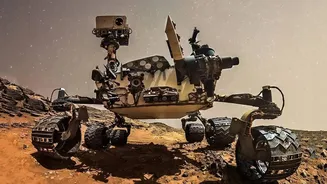
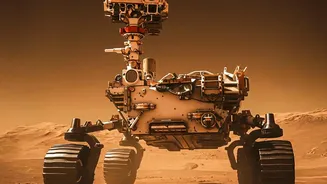
Perhaps the most futuristic application of AI is in creating autonomous spacecraft and rovers. On Mars, the Perseverance rover uses AI to navigate the terrain on its own, analyzing images to identify and avoid hazards without direct commands from Earth for much of its journey. Its instruments also use AI to identify promising rock samples to analyze for signs of ancient life. Looking ahead, NASA is developing new, radiation-hardened computer chips that will give spacecraft hundreds of times the processing power they have now. This could enable future missions to deep space to make their own decisions, prioritize scientific observations, and analyze data on the fly, transforming them from remote-controlled probes into true robotic explorers.