






Why Humidity Sabotages Your Body's Cooling System
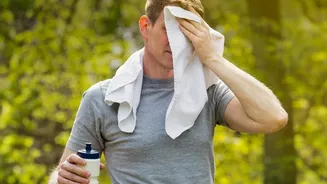
On a normal day, your body has a brilliant cooling system: you sweat. As that sweat evaporates from your skin, it takes heat with it, keeping your core temperature in a safe range. High humidity throws a wrench in this process. Humidity is the measure
of moisture already in the air. When the air is saturated with water vapor, your sweat has nowhere to go. Evaporation slows down dramatically or stops altogether, leaving you covered in sweat that isn't actually cooling you. As a result, your internal temperature starts to climb, and your body has to work much harder to prevent overheating.
The Real Danger: Heat Index, Not Just Temperature
This is why runners and outdoor enthusiasts learn to fear the dew point and the heat index. The heat index combines air temperature with humidity to give you a “feels like” temperature, which is a more accurate measure of the stress on your body. For example, a 90-degree day with 70% humidity can feel like 105 degrees. Your heart has to pump harder to send blood to both your working muscles and to your skin in an attempt to release heat. This increased cardiovascular strain means your heart rate will be significantly higher at a pace that normally feels easy. Ignoring this and pushing to hit your usual numbers is a recipe for trouble.
Know the Warning Signs of Heat Illness
When your body can no longer cope with the heat, you risk heat-related illnesses. The first stage is often heat exhaustion, and its symptoms can be subtle at first but should never be ignored. Watch out for dizziness, nausea, headache, unusual fatigue, heavy sweating, or sudden muscle cramps. You might also notice your skin is cool and moist despite the heat. If you experience any of these signs, you must stop all activity immediately, move to a cooler place, and start drinking water. If symptoms don't improve within an hour or if confusion, slurred speech, or loss of consciousness occur, it could be heatstroke, a life-threatening emergency that requires immediate medical attention.
Shift Your Focus from Pace to Effort
The single most important adjustment for exercising in humidity is to let go of your pace goals and run by effort instead. A run that feels like a 6 out of 10 effort in ideal weather is the effort you should aim for, regardless of what your watch says. Your pace will naturally be slower, and that’s not a sign of lost fitness—it’s a sign of smart training. Some coaches offer rules of thumb, such as adding 20 to 30 seconds per mile for every 5-degree increase above 60°F, but even this doesn't fully account for humidity. A better method is using the sum of the temperature and dew point to estimate a pace slowdown; for instance, if the temperature is 80°F and the dew point is 70°F, the total is 150, which suggests your pace could be 3% to 4.5% slower for the same effort.
Smart Strategies for Humid Workouts
Beyond adjusting your pace, several other strategies can help you manage humid conditions. The most obvious is to time your workouts for cooler parts of the day, like the early morning or late evening. Proper hydration is also non-negotiable. Start drinking water hours before your workout, and continue sipping every 15-20 minutes during your activity. For sessions lasting longer than 45-60 minutes, an electrolyte drink is essential to replace the salts you lose through sweat. Finally, choose lightweight, light-colored, and moisture-wicking clothing to help what little evaporation is possible occur more easily.