


A Sweet Discovery in the Stars
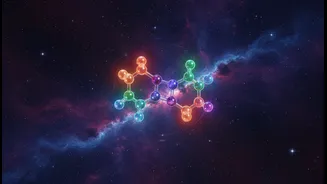
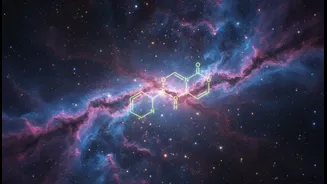
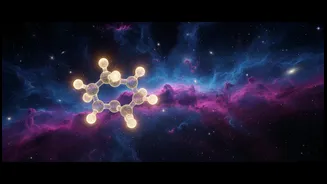
A team of astronomers recently detected a four-carbon sugar called erythrulose in a dense cloud of gas and dust near the centre of our Milky Way galaxy. This isn't the sugar you put in your chai; erythrulose is found naturally in things like raspberries.
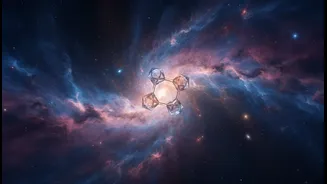
Using powerful radio telescopes in Spain, scientists identified the unique chemical signature of this molecule floating in the interstellar medium—the seemingly empty space between stars. While simpler molecules have been found before, the detection of a more complex sugar like this is a significant step. It suggests that the chemical processes in these stellar nurseries are far more sophisticated than previously thought, capable of creating some of the fundamental ingredients necessary for biology before planets even begin to form.
More Than Just Empty Space
The interstellar medium is not truly empty. It’s a vast, cold, and low-density mix of gas and dust. Yet, within these clouds, cosmic chemistry is hard at work. Bombarded by radiation, simple molecules like water and methane on icy dust grains can react to form more complex structures. Scientists have identified over 200 different molecules in space, many of them organic, meaning they are carbon-based like life on Earth. Finding complex organic molecules (COMs) like erythrulose confirms that the universe is a massive organic chemist's laboratory. This particular sugar is important because, while not a direct component of our genetics, it can easily be converted into other sugars that are considered crucial precursors to the first building blocks of life.
The 'RNA World' Hypothesis
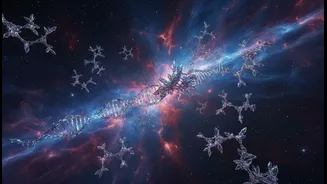
So, why is finding sugar in space so exciting? It feeds into a leading theory about the origin of life known as the "RNA World" hypothesis. Life today relies on a complex partnership between DNA (which stores our genetic blueprint) and proteins (which carry out cellular tasks). However, many scientists believe a simpler system came first, one based on RNA (ribonucleic acid). RNA is fascinating because it can both store genetic information, like DNA, and catalyse chemical reactions, like proteins. The backbone of RNA is made from a five-carbon sugar called ribose. In 2019, scientists found ribose directly in meteorite samples that had fallen to Earth, providing the first direct evidence that these critical sugars could have been delivered from space.
A Cosmic Delivery Service
The discovery of erythrulose in an interstellar cloud, and ribose in meteorites, strengthens the idea that Earth may have received some help in its journey toward life. The hypothesis suggests that during the early, chaotic period of our solar system, asteroids and comets frequently bombarded our planet. These cosmic messengers could have delivered a cocktail of essential ingredients—including water, amino acids, and sugars—to the sterile, primordial Earth. Finding these molecules in the very clouds where stars and planets are born, as well as in the asteroids that are leftovers from that formation process, completes a crucial part of the story. It shows that the building blocks of life aren't necessarily rare; they are widespread throughout the galaxy.
The Missing Piece of the DNA Puzzle
Interestingly, while researchers have found the sugar for RNA (ribose) in meteorites, the sugar for DNA (2-deoxyribose) has been notably absent from these samples. Lab experiments have shown that 2-deoxyribose can be formed under space-like conditions, but its absence in actual asteroid samples suggests it might be less stable or less commonly produced. This observation lends further weight to the RNA World hypothesis—the idea that life started with the more readily available ribose-based RNA, and the more stable DNA evolved later. The continuous discovery of these prebiotic molecules in space helps scientists refine their understanding of the precise chemical pathways that could lead from simple stardust to living organisms.