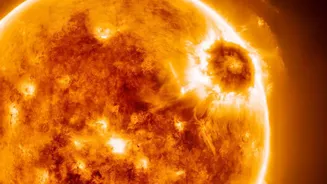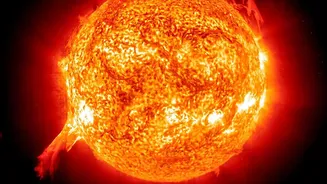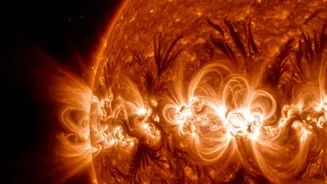

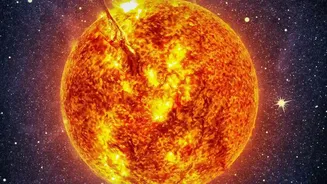
Studying the Sun's violent eruptions is like staring into a spotlight. Now, a clever partnership between India's Aditya-L1 and Europe's Proba-3 is creating a unique 'two-eyed' view to uncover the secrets hidden in the solar glare.
India's Unblinking Eye on the Sun
At the heart of this
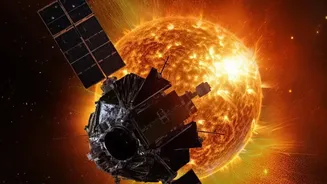
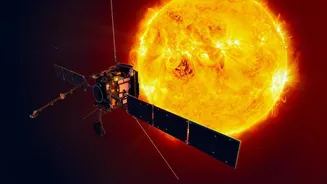
collaboration is India's first dedicated solar mission, Aditya-L1. Launched by ISRO in September 2023, the spacecraft is strategically positioned at Lagrange Point 1 (L1), a gravitationally stable spot about 1.5 million kilometres from Earth. From this vantage point, it has an uninterrupted view of the Sun, acting as a constant sentinel for solar activity. Aditya-L1 is equipped with seven sophisticated instruments designed to observe the Sun's atmosphere, from its surface to its outermost layer, the corona. Its primary payload, the Visible Emission Line Coronagraph (VELC), is crucial for this joint effort. It studies the solar corona and the dynamics of coronal mass ejections (CMEs) — massive eruptions of plasma and magnetic fields from the Sun.
Europe's Innovative 'Artificial Eclipse'
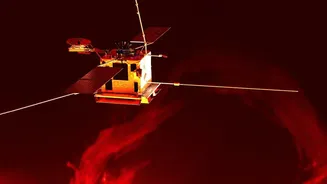
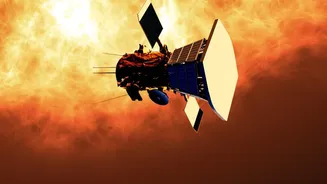
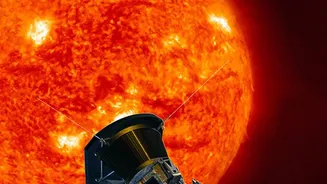
The European Space Agency's (ESA) Proba-3 mission brings a groundbreaking technology to the partnership. Launched in December 2024 aboard an ISRO PSLV rocket, it is the world's first precision formation-flying mission. Proba-3 consists of two separate satellites flying in a precise alignment, about 150 metres apart. One satellite, the 'Occulter', blocks the bright disc of the Sun, casting a perfect shadow over the second satellite, the 'Coronagraph'. This manoeuvre creates a prolonged artificial solar eclipse, allowing its ASPIICS instrument to capture incredibly detailed images of the Sun's faint, inner corona, a region notoriously difficult to observe. It's a technological feat that provides a view previously only possible for brief moments during natural eclipses.
A Synergy Forged in Science
The real magic happens when these two missions combine their observations. They are not just two separate missions looking at the Sun; they are working in tandem to create a more complete picture than either could achieve alone. Aditya-L1's VELC provides spectroscopic data, which helps scientists understand the temperature, density, and speed of the material in a solar eruption. Meanwhile, Proba-3's ASPIICS provides sharp, clear images of the eruption's shape and structure as it leaves the Sun. This combination allows researchers, led by scientists at the Indian Institute of Astrophysics, to cross-check their data and build a comprehensive, 3D-like understanding of how these powerful events begin and evolve. The first joint analysis of CMEs observed in September 2025 has already demonstrated the immense potential of this coordinated approach.
Hunting the Sun's Violent Storms
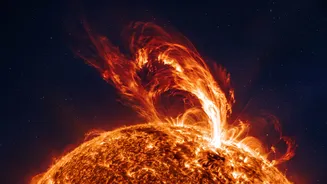
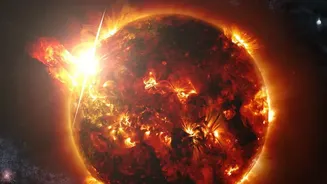
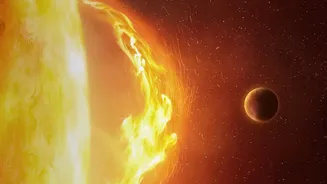
The primary targets of this joint effort are Coronal Mass Ejections (CMEs) and solar flares. These are the most powerful explosions in our solar system. A single CME can release billions of tonnes of plasma and magnetic fields into space at incredible speeds. Observing these events in their earliest moments, very close to the Sun's surface, has always been a major challenge for scientists. Past instruments struggled to see the faint, early stages of CMEs against the Sun's overwhelming brightness. This left critical gaps in our understanding of how their energy is structured and released. By combining Aditya_L1's broad context with Proba_3's close_up, high_fidelity view, scientists can finally track the initial acceleration and energy distribution of CMEs, a crucial step in predicting their journey through space.
Why This Solar Science Matters on Earth
This deep_space research has very down_to_Earth implications. When solar eruptions are aimed at our planet, they can trigger 'space weather' events like geomagnetic storms. These storms can have serious consequences for our technology_dependent society. They can disrupt satellite operations, affecting everything from GPS navigation and telecommunications to banking systems. They can also create harmful radiation for astronauts and even passengers on high_altitude polar flights, and in extreme cases, induce currents that can overload and damage electrical power grids on the ground. By gaining a better understanding of how CMEs form and accelerate, this India_Europe collaboration provides critical data to improve our space weather forecasting models. This, in turn, helps us better protect our vital infrastructure both in space and on Earth.