

A New Window on Alien Worlds
For centuries, astronomers were limited to what they could see in visible light. But many of the universe's most fascinating secrets are hidden in wavelengths our eyes can't detect. Infrared light, which we perceive as heat, offers a unique window into
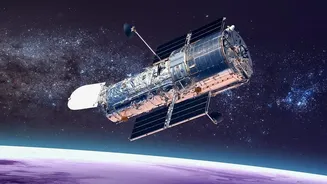
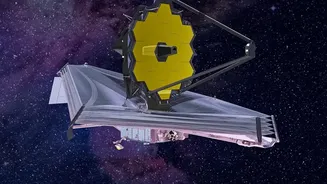
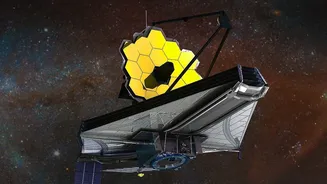
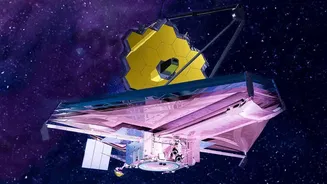
the cosmos. Space telescopes like the James Webb Space Telescope (JWST) are designed specifically to see in infrared, allowing them to cut through cosmic dust and analyse the chemical makeup and temperature of objects trillions of kilometres away. This technology is particularly powerful for studying exoplanets—planets orbiting other stars. By capturing the faint infrared glow of these worlds, or by analysing the starlight that filters through their atmospheres, astronomers can create detailed weather maps of places we will never visit.
Winds Faster Than the Speed of Sound
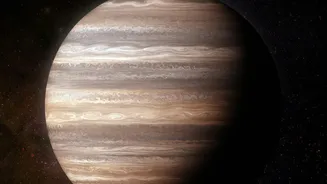
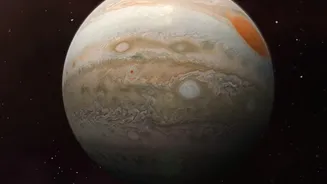
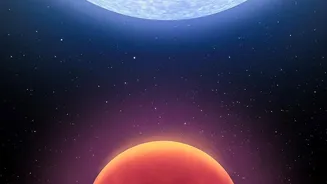
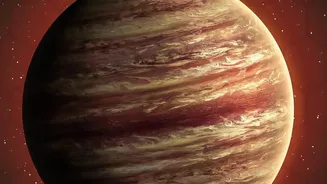
On Earth, the fastest winds in a Category 5 hurricane are terrifying. On some exoplanets, they would feel like a gentle breeze. Using high-resolution spectrographs on telescopes like the Very Large Telescope (VLT), astronomers have clocked winds on gas giants that are truly mind-boggling. One such world is WASP-127b, a 'puffy' gas giant larger than Jupiter but with much less mass, located over 500 light-years away. Observations revealed a powerful jetstream at its equator with winds raging at up to 33,000 km/h. This is a supersonic wind, moving faster than the speed of sound in that atmosphere. These extreme speeds are driven by the immense temperature differences on these planets, many of which are 'tidally locked', meaning one side permanently faces their star while the other is trapped in endless night. The intense heat from the star supercharges the atmosphere, creating global wind patterns that dwarf anything in our own solar system.
When It Rains Liquid Iron
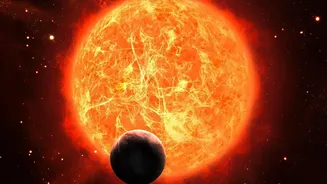
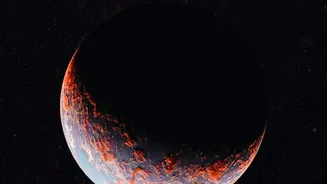
The phrase 'iron rain' sounds like something from a fantasy novel, but it's a very real weather phenomenon on ultra-hot gas giants. Take the exoplanet WASP-76b, for example. This planet orbits so close to its star that its dayside temperatures can exceed 2,400 degrees Celsius—hot enough to vaporise metals. Elements like iron, which are solid rocks on Earth, turn into a gas in the planet's atmosphere. These metallic vapours are then carried by powerful winds to the cooler nightside of the planet. On the nightside, which is still incredibly hot by Earth standards, the temperature drops enough for the iron gas to condense into liquid droplets. These droplets then fall from the sky as a rain of molten iron. This astonishing discovery was made by observing the chemical signature of iron vapour on the planet's evening 'terminator,' the line where day turns to night, and noticing it was absent at the 'morning' terminator, suggesting it had rained out during the night.
How Exactly Do They See This?
Detecting these phenomena from light-years away is a triumph of scientific ingenuity. The primary method is called transit spectroscopy. When an exoplanet passes in front of its host star from our point of view, a tiny fraction of the starlight shines through the planet's atmosphere. Different chemical elements absorb specific wavelengths (or colours) of light. By analysing which colours are missing from the starlight after it passes through the atmosphere, astronomers can identify the presence of elements like iron, water, or even quartz crystals. To measure wind speed, they look for a Doppler shift in these chemical signatures. As winds move part of the atmosphere towards us, the light waves are compressed (blueshifted), and as they move away, the waves are stretched (redshifted). By measuring the extent of this shift, they can calculate the wind's velocity with incredible precision.