





Our Farthest Day from the Sun
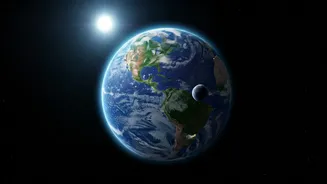
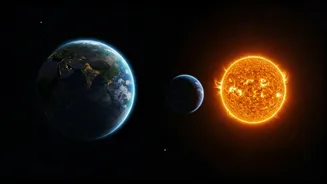
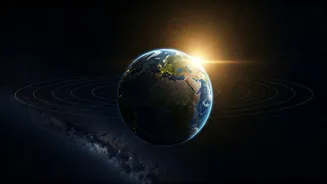
Every year around this time, the Earth reaches a special point in its orbit called 'aphelion'. The name comes from Greek roots: 'apo' meaning away, and 'helios' meaning the Sun. On July 6, 2026, Earth will be at its farthest point from the Sun for the entire
year, a staggering distance of about 152.1 million kilometres. Six months from now, in early January, we will be at our closest point, 'perihelion', at roughly 147.1 million kilometres away. While a difference of five million kilometres sounds enormous, it only represents about a three percent variation in our total distance from the Sun, as our planet’s orbit is very nearly a perfect circle.
The Summer Paradox
Here is where things get interesting, especially for us in the Northern Hemisphere. If you ask most people, it makes sense that we are closer to the sun in summer and farther away in winter. It’s an intuitive thought — closer to the fire, warmer the room. Yet, the reality is the complete opposite. Earth reaches its maximum distance from the sun right in the middle of summer in the Northern Hemisphere. The sweltering heat of an Indian summer is happening when our planet is at its most distant from the solar furnace. This simple fact is a powerful reminder that our seasons are not dictated by distance.
The Real Reason for the Seasons
So, if distance isn't the cause, what is? The answer lies in the tilt of the Earth's axis. Our planet is tilted at an angle of about 23.5 degrees. This tilt means that for part of the year, the Northern Hemisphere is angled more directly towards the sun. The sun's rays hit us at a steeper, more direct angle, concentrating their energy and leading to warmer weather and longer days. During this same period, the Southern Hemisphere is tilted away, experiencing winter. The seasons are therefore a result of the direction of the Earth's tilt, not its proximity to the Sun. Aphelion on July 6 serves as a perfect annual lesson in this fundamental concept of astronomy.
A Longer, Lazier Summer
This orbital quirk has another subtle but fascinating effect. Four centuries ago, the astronomer Johannes Kepler figured out that a planet moves slowest when it is farthest from the star it orbits. As Earth reaches aphelion in early July, it is moving at its most leisurely pace through space. This cosmic slowdown has a direct impact on our calendar. Because our planet lingers in this distant part of its orbit during the Northern Hemisphere's summer, it actually makes our summer the longest season of the year, by nearly five days compared to our winter. Conversely, in the Southern Hemisphere, summer is the shortest season because the Earth is zipping along at its fastest during perihelion in January.