




Cosmic Messengers
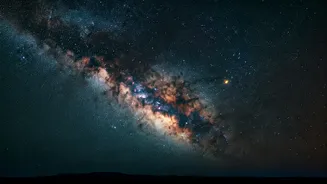
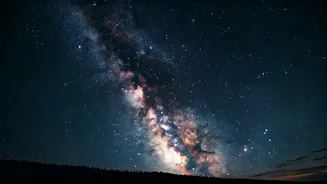
The feeling is universal. Staring into the night sky can bring a sense of peace and wonder. But the science behind what you’re seeing is even more mind-bending than the view itself. Every single star, from the brightest beacon to the faintest twinkle,
is a time capsule. Light, while the fastest thing in the universe, isn't instantaneous. It travels at a blistering pace of nearly 300,000 kilometres per second. Over the immense, almost incomprehensible distances of space, this journey takes time. A lot of time. Astronomers use a unit called a 'light-year' to measure these distances. It’s not a measure of time, but of distance: the distance light travels in one year. That’s about 9.5 trillion kilometres. So when we say a star is 100 light-years away, it means the light you see tonight began its journey from that star 100 years ago. You are, quite literally, looking into the past.
Greetings from the Past
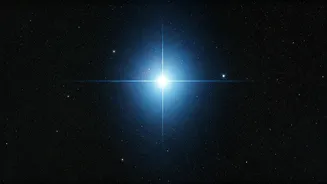
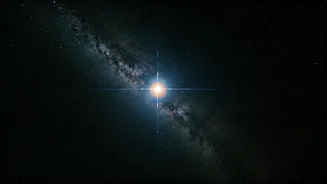
Let’s make this personal. Go outside and find the brightest star in the night sky. That’s likely Sirius, known in India as Vyadha. It's a brilliant, bluish-white star. Sirius is about 8.6 light-years away. This means the light hitting your eyes tonight left the star around late 2015. You’re seeing Sirius as it was when India was launching its first dedicated space observatory, Astrosat. Now consider a star like Rohini (Aldebaran), the reddish eye of the Vrishabha (Taurus) constellation. It’s about 65 light-years away. The light we see from Rohini tonight started its journey around 1959. That was the year ISRO’s predecessor, INCOSPAR, was still a decade away from being formed and the world was captivated by the early space race. What about the Pole Star, Dhruva? It’s roughly 433 light-years away. The light we see from it today set out around the year 1591, when the Mughal emperor Akbar was ruling most of the subcontinent. Every star is a history lesson, a snapshot from a different era.
The Ultimate Time Machine
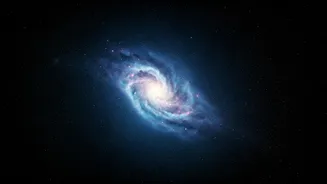
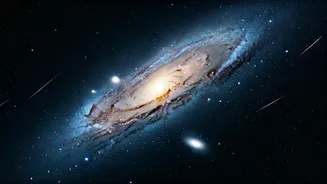
This principle isn't just a fun fact; it’s the cornerstone of modern astronomy. A telescope isn’t just a tool for magnification; it's a time machine. The more powerful the telescope, the farther it can see into space, and therefore, the further back in time it can look. When astronomers point instruments like the Hubble Space Telescope or the James Webb Space Telescope at the most distant galaxies, they aren't seeing them as they are now. They are seeing them as they were billions of years ago, shortly after the Big Bang. They are observing the birth of the first galaxies and the formation of the first stars. This cosmic time travel allows scientists to piece together the history of the universe itself, from its chaotic infancy to the sprawling cosmos we know today. The light that left those ancient galaxies when the universe was young has been travelling through space for over 13 billion years, finally reaching our detectors here on Earth to tell its story.
A Sky Full of Ghosts
The flip side of this cosmic time delay is both poignant and dramatic. Because the light takes so long to reach us, a star we see shining brightly in our sky tonight might not even exist anymore. It could have exploded in a supernova or collapsed into a black hole centuries ago, and we simply haven't received the 'news' yet. The light from its final moments is still on its way. A famous candidate for this is Betelgeuse, the reddish shoulder of the Mriga (Orion) constellation. It’s a red supergiant star nearing the end of its life, located about 640 light-years away. Astronomers know it will explode in a spectacular supernova, but 'soon' in cosmic terms could mean tomorrow or 100,000 years from now. If it exploded 500 years ago, we would still see it shining calmly for another 140 years before its cataclysmic end becomes visible to us.