




Meet the Roman Space Telescope
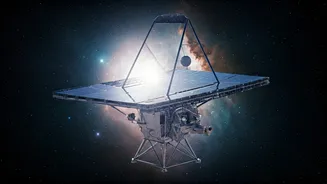
NASA's next great observatory is the Nancy Grace Roman Space Telescope, an infrared observatory set to continue the legacy of its famous predecessors. [4] Named after Nancy Grace Roman, NASA's first chief of astronomy and the “Mother of Hubble,” this
mission is poised to tackle some of the biggest questions in astrophysics. [5] Having completed its construction and testing, the telescope arrived at Kennedy Space Center in Florida on June 21, 2026, for final launch preparations. [13, 14] The mission is currently scheduled to launch no earlier than August 30, 2026, aboard a SpaceX Falcon Heavy rocket, a timeline that puts the project months ahead of its official schedule. [9, 14]
A Panoramic View of the Cosmos
While Roman features a primary mirror the same size as Hubble's—2.4 meters in diameter—its power lies in its extraordinary field of view. [19] Its Wide Field Instrument (WFI) can capture a patch of the sky at least 100 times larger than Hubble can in a single pointing, while maintaining similar exquisite resolution. [3, 19] Think of it as the difference between looking at the universe through a keyhole versus a panoramic window. This capability will allow Roman to conduct massive sky surveys with incredible efficiency, creating vast cosmic maps that would have taken Hubble centuries to produce. [3, 16] A single image from Roman will hold the detail equivalent to 100 pictures from Hubble. [19]
The Hunt for Dark Energy
One of Roman's primary scientific goals is to unravel the mystery of dark energy, the enigmatic force causing the universe's expansion to accelerate. [4] To do this, Roman will embark on a multi-pronged investigation. [2] It will map the distribution of galaxies and galaxy clusters over cosmic time to see how dark energy has influenced the large-scale structure of the universe. [5] It will also hunt for thousands of distant supernovae, using them as cosmic mile-markers to measure the expansion rate of the universe with incredible precision. [5, 18] By combining these methods, scientists hope to determine whether dark energy is a constant force or something that has changed over time. [2]
A Census of a Billion Worlds
Roman is also a revolutionary planet-hunting machine. While the Kepler and TESS missions found thousands of planets by looking for the slight dimming of a star as a planet transits, or passes in front, Roman will primarily use a different technique called gravitational microlensing. [1, 11] This method detects planets by observing how their gravity, and that of their star, bends and magnifies the light from a more distant, unrelated star. This technique is sensitive enough to find planets down to the mass of Mars, including free-floating "rogue" planets that don't orbit a star at all. [1, 3] Scientists anticipate Roman will discover over 100,000 new exoplanets during its mission, dramatically increasing our planetary census. [13]
Seeing Planets Directly
In addition to its wide-field camera, Roman carries a groundbreaking technology demonstration: the Coronagraph Instrument. [6] A coronagraph works by blocking the overwhelming glare of a star, allowing the much fainter light from an orbiting planet to be seen directly. [10] Roman's coronagraph is projected to be 100 to 1,000 times more powerful than previous space-based versions, capable of imaging Jupiter-sized planets. [6] While considered a tech demo, its success will pave the way for future missions, like the Habitable Worlds Observatory, which aim to directly image and study Earth-like planets around other stars. [6, 15]