

The Seven Minutes of Terror
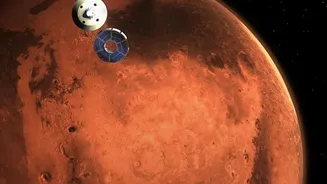
Engineers at NASA call the entry, descent, and landing (EDL) phase the 'seven minutes of terror'. This is because it takes about seven minutes for a spacecraft to get from the top of the Martian atmosphere to the ground, but due to the vast distance,
radio signals can take over 11 minutes to reach Earth. By the time mission control receives the signal that the spacecraft has entered the atmosphere, the vehicle is already either safely on the surface or has crashed. The core of the problem lies in Mars's atmosphere. It is less than 1% as dense as Earth's, which means it is too thin to slow a spacecraft down sufficiently with just a parachute. However, it is just thick enough to generate incredible friction and heat, with temperatures on the heat shield reaching around 1,300 to 1,600 degrees Celsius. This creates a paradox: the atmosphere is dangerous enough to incinerate a craft but not helpful enough to land it gently. Every single step must be executed flawlessly and autonomously by the onboard computer.
The Robotic Solution: A Proven, Delicate Dance
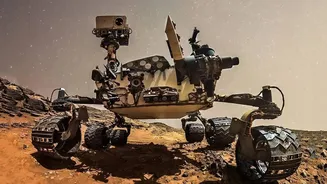
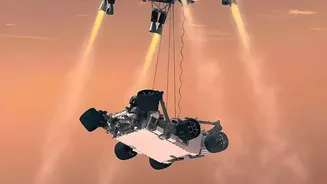
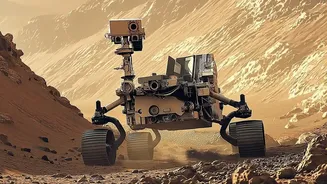
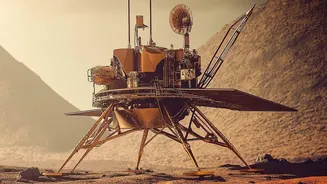
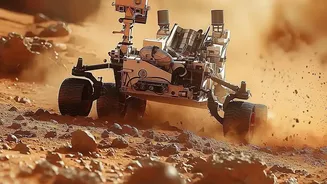
To date, we have only ever landed robots on Mars. For car-sized rovers like Curiosity and Perseverance, NASA developed an ingenious, multi-stage system. After the heat shield protects the craft during initial entry, a massive supersonic parachute deploys at nearly twice the speed of sound to handle the initial deceleration. But because this isn't enough, the lander must cut itself free from the parachute and fire retrorockets to slow down further. The final, and most famous, piece of the puzzle is the 'sky crane' maneuver. To avoid kicking up rocks and dust that could damage the rover, a rocket-powered jetpack hovers about 20 metres above the surface and gently lowers the rover to the ground on three nylon cables. Once the rover's wheels touch down, the cables are cut, and the sky crane flies away to crash at a safe distance. This highly complex sequence has worked brilliantly, but it is designed for a payload of around one metric ton.
The Human-Sized Problem of Mass
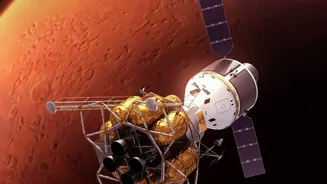
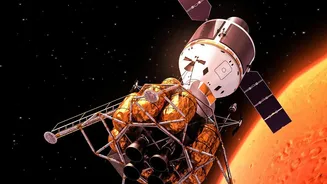
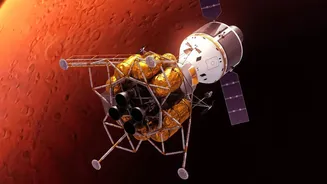
The elegant sky crane solution simply does not scale up for a human mission. While the Perseverance rover weighed about one metric ton, a spacecraft carrying astronauts, life support, supplies, and a return vehicle could weigh anywhere from 50 to 100 metric tons. The physics of atmospheric braking do not favour heavy objects. A more massive vehicle has far more inertia and is much harder to slow down in Mars's thin air. The parachutes and sky crane system that work for a car-sized robot would be utterly insufficient for a human-rated lander. This leap in mass, a fifty-fold increase or more, is the central engineering challenge. It requires a fundamental shift in landing technology, moving away from heritage systems that are reaching their physical limits.
New Technologies for a New Challenge
To land a multi-ton human habitat on Mars, engineers are looking at a technique called supersonic retropropulsion. This involves firing powerful engines directly into the supersonic airflow as the spacecraft descends, using raw thrust to decelerate where the atmosphere can't. Companies like SpaceX are designing their Starship vehicle to perform this maneuver, entering the atmosphere, using its heat shield, and then firing its large Raptor engines to perform a powered descent and landing. This approach eliminates the need for complex parachutes and sky cranes. Furthermore, human missions will require pinpoint landing accuracy, needing to touch down within metres of pre-deployed habitats or equipment. This demands advanced navigation systems that can identify hazards and select a safe landing spot in real-time, a significant step up from the kilometres-wide landing ellipses of past robotic missions.
The Unforgiving Safety Imperative
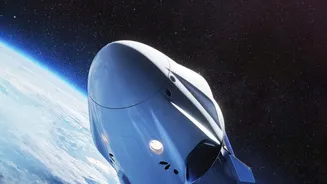
Beyond the sheer difference in mass and technology, there is a profound philosophical difference between landing a robot and landing people. While losing a billion-dollar rover would be a devastating setback, the risk is ultimately financial and scientific. For a crewed mission, the tolerance for failure is near zero. Human-rated systems require layers of redundancy and abort capabilities that are not necessary for robotic explorers. Every system, from the heat shield tiles to the landing leg actuators, must be rigorously tested and proven to be exceptionally reliable. The presence of astronauts also complicates the landing itself; their vehicle must provide a gentle enough touchdown to avoid injury and must land upright and stable on potentially uneven terrain without the benefit of a prepared landing pad. This safety imperative drives up the complexity, cost, and weight of the entire system, making the already monumental challenge even greater.