

A New Look at the Sun's Surface
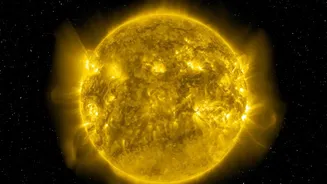
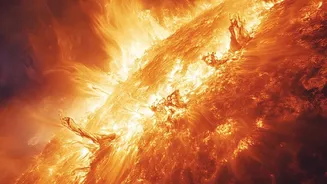
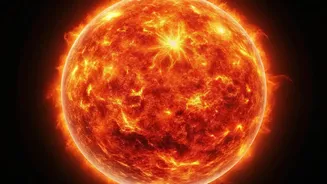
Using the powerful Daniel K. Inouye Solar Telescope in Hawaii, scientists have captured the most detailed images ever of the sun's surface, known as the photosphere. These unprecedented images revealed tiny, swirling vortices of plasma at the edges of solar
granules—the bubbling patterns of plasma that cover the sun. These newly observed whirlpools, some as small as 19 kilometres wide, are evidence of a phenomenon called Kelvin-Helmholtz instability, which was theorised but never directly seen on the sun's surface until now. This instability occurs when two fluids, or in this case plasmas, flow past each other at different speeds, creating a shear that grows into swirling vortices.
Unlocking an Energy Transfer Mystery
One of the longest-standing puzzles in solar physics is the coronal heating problem: why the sun's outer atmosphere, the corona, is millions of degrees hotter than its surface. The discovery of these tiny vortices offers a significant clue. Scientists believe these swirling motions twist the sun's magnetic field lines, building up magnetic energy like a coiled spring. This stored energy can then be released, potentially contributing to the heating of the corona. These vortices act as small but numerous 'motors' of magnetic energy, providing a new perspective on how energy is transported from the sun's interior to its upper atmosphere.
The Link to Solar Eruptions
The same process that may heat the corona could also be a trigger for more violent solar events. The energy built up by the twisting magnetic fields can become unstable and release suddenly, leading to solar flares and coronal mass ejections (CMEs). These large-scale explosions send massive amounts of radiation and charged particles into space. By observing the Kelvin-Helmholtz instability at this small scale, scientists can better understand the fundamental physics that drive these much larger and more powerful solar outbursts. In essence, these tiny whirlpools might be the starting point for the dramatic space weather events that can impact Earth.
Improving Space Weather Forecasts
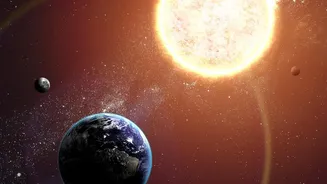
Understanding the origins of solar flares and CMEs is crucial for predicting space weather. When directed at Earth, these solar storms can have significant consequences, disrupting radio communications, damaging satellites, and even causing blackouts in power grids. The ability to observe the underlying mechanisms, like these newly seen plasma waves, provides a foundation for better forecasting models. By identifying the conditions that lead to these instabilities, scientists hope to eventually provide earlier and more accurate warnings for potentially disruptive space weather events, helping to protect our increasingly technology-dependent society.
A New Era of Solar Observation
This discovery was made possible by the incredible resolution of the Daniel K. Inouye Solar Telescope, which can see features on the sun's surface with unprecedented clarity. This technological leap, combined with sophisticated computer simulations, allows researchers to test theories that were previously impossible to verify through direct observation. The ability to resolve structures as small as these vortices opens a new window into the sun's complex magnetic environment. It marks a major step forward in our understanding of how minute processes can have a significant impact on the nature of our star.