



Kinnaur: A World Apart
Nestled on the historic Hindustan-Tibet road, the Kinnaur region is a world away from the crowded hill stations of lower Himachal. As you drive past the dramatic rock-cut roads along the Sutlej River, the landscape shifts from lush forests to a more rugged,
awe-inspiring terrain. This is a land of high peaks, deep gorges, and vibrant culture, where life moves at a different pace. For travellers keen on mountain vistas, Kinnaur offers two of its finest jewels: Sangla Valley and Kalpa village. They are relatively close to each other, yet they provide two fundamentally different perspectives on the Himalayas.
Sangla: Immersed in the Valley
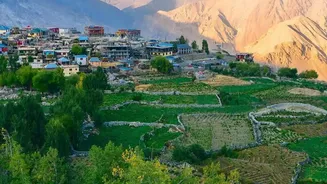
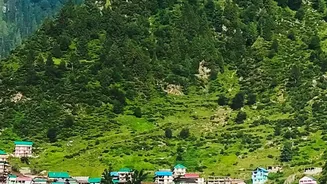
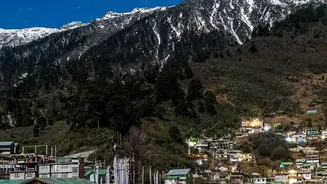
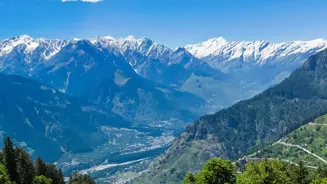
Turning off the main highway at Karcham, you enter the Baspa Valley, often simply called Sangla Valley. The transition is immediate. The landscape opens up into a wide, verdant river valley, flanked by steep, forested slopes and snow-dusted peaks. The Baspa River, with its clear turquoise water, flows through the heart of it all. The experience here is one of immersion. You are in the valley, surrounded by mountains. The scenery is pastoral and serene, with picturesque villages like Batseri and Rakcham, fields of buckwheat, and dense forests of pine and deodar. Sangla Valley is perfect for travellers who want to feel the gentle embrace of the mountains, walk along a rushing river, and experience the charm of Himalayan village life up close.
Kalpa: A Balcony with a Heavenly View
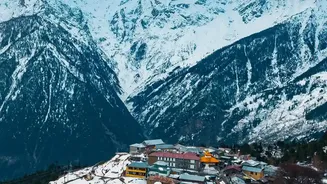
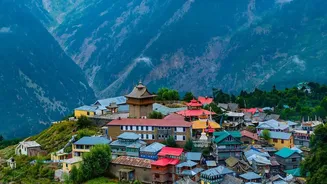
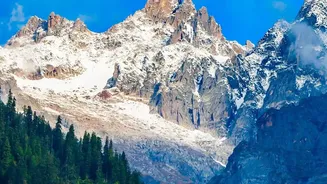
If Sangla is about being inside the landscape, Kalpa is about witnessing it from a majestic balcony. Perched high above the Sutlej River gorge, Kalpa offers what is arguably one of the most magnificent panoramic views in the Indian Himalayas. The entire village faces the monumental Kinner Kailash range, a wall of rock and ice that dominates the skyline. The prime attraction is watching the sunrise, when the first rays of light hit the sacred Kinner Kailash peak (6,050 metres) and its adjacent Shivling pillar, painting them in hues of pink, copper, and gold. This is a landscape of grandeur and scale. From your hotel balcony or a quiet lane in the village, you gaze across the deep valley at these colossal peaks, feeling a sense of profound awe. The view is framed by the village's famous apple orchards, adding a touch of green to the epic panorama.
A Tale of Two Landscapes
What makes a trip to this region so fulfilling for a landscape lover is the contrast. Sangla Valley gives you the idyllic, romantic mountain experience. It’s about gentle slopes, flowing water, and the feeling of being enclosed by nature's beauty. Kalpa, on the other hand, delivers raw, dramatic power. It's an elevated, front-row seat to the high Himalayas, offering a perspective that makes you feel small in the face of such magnitude. Experiencing both allows a traveller to appreciate the different moods of the mountains. You can spend days exploring the lushness of the Baspa Valley and then drive just a couple of hours to be mesmerized by the sheer scale of the Kinner Kailash massif. Together, they create a complete journey.
When to Go for the Best Views
Timing your visit can enhance the experience. Spring (April to June) offers pleasant weather with blooming apple orchards in Kalpa and lush greenery in Sangla. However, for the clearest and most dramatic mountain views, the post-monsoon season of September and October is unparalleled. During this time, the air is crisp, the skies are a deep blue, and the peaks are sharply defined against the horizon. This is also the apple harvesting season, adding vibrant colour and activity to the landscape. Winter (December to February) blankets the region in snow, creating a magical, serene landscape, though road access can sometimes be challenging.