





What Are Content Credentials?
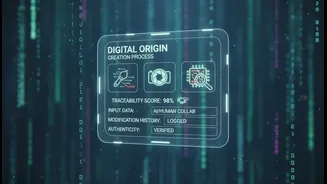
Think of Content Credentials as a digital nutrition label for media. It's information securely attached to a file—like a photo, video, or document—that provides a verifiable history of its origins. This data can show who created the content, what tools
were used (including AI generators), and what edits were made along the way. This system is built on an open standard called C2PA (Coalition for Content Provenance and Authenticity), a project backed by a consortium of major tech and media companies like Adobe, Microsoft, Google, Sony, and the BBC. The goal isn't to block or censor content, but to introduce a layer of transparency into our increasingly murky digital ecosystem. The information is cryptographically signed, making it tamper-evident; if someone tries to alter the file or its history, the digital seal breaks, making the change detectable.
A Verifiable Digital Paper Trail
So how does this work in practice? The process creates a chain of custody for a digital file. It starts at the source: a C2PA-enabled camera can sign an image the moment it’s captured, logging the device and time. When that image is opened in compatible software like Adobe Photoshop, any significant edits—such as cropping, colour adjustments, or the use of generative AI—are recorded in an updated manifest. This creates an additive history, where each step is layered onto the last without erasing what came before. When you view the final image on a platform that supports Content Credentials, you can inspect this attached data to see its entire journey from camera to your screen. It provides a factual history, or provenance, allowing viewers to make their own informed decisions.
The Value Is History, Not a 'Truth' Stamp
This is where the crucial distinction lies. Content Credentials do not, and cannot, tell you if the subject of a photo is “true.” A perfectly authentic, camera-captured image with a valid credential can still be used to mislead. A photo can be staged, a caption can be deceptive, or the framing can remove crucial context. All the credential proves is that the file itself is what it claims to be: a photograph from a specific camera, edited in a specific way. The system provides transparency about the asset's history, not a judgment on the narrative it's being used to support. Its power comes from revealing the ‘how,’ not certifying the ‘what.’ Knowing an image was generated by AI or heavily manipulated in Photoshop is vital context that empowers viewers to think critically.
Understanding the Limitations
It's important to be clear about what this technology cannot do. The most significant loophole is that credentials can be stripped. Simply taking a screenshot of an image creates a brand-new file with no history, a vulnerability often called the "analog hole." Furthermore, many social media platforms and email clients historically stripped metadata to save space, breaking the chain of authenticity, though this is slowly changing. There's also the "missing label" problem: as we learn to trust content with credentials, we may unfairly distrust the billions of legitimate photos and videos that were created without them. The absence of a credential doesn't mean a file is fake. A C2PA manifest certifies the file, not the reality it depicts; you can take a validly signed photo of a screen displaying a deepfake.
Fostering a New Kind of Digital Literacy
Instead of seeking a simple, binary 'real' or 'fake' label, we should see Content Credentials as a tool for fostering a more sophisticated form of digital literacy. The system encourages us to move beyond gut reactions and ask better questions. Where did this image come from? Has it been altered? Was AI involved? The answers provide a foundation for conditional trust, where we evaluate content based on its verifiable provenance. This technology is not a cure for misinformation, but it is a powerful treatment. It restores a sense of accountability by giving creators a way to stand by their work and giving audiences the tools to inspect what they see. The goal is not to have technology tell us what to believe, but to give us the information needed to decide for ourselves.