




An Alien Earth
Titan is one of the most intriguing bodies in the solar system. Larger than the planet Mercury, it is the only moon known to have a dense atmosphere, which is about 60 percent thicker than Earth's at the surface. This atmosphere, a thick, orange haze
of nitrogen and methane, completely hides the surface in visible light. But what lies beneath is a bizarre landscape sculpted by processes eerily similar to our own. Titan has an Earth-like cycle of liquids, but with a crucial difference: it’s a cycle of liquid hydrocarbons like methane and ethane, not water. These hydrocarbons form clouds, rain down, carve river channels, and pool into vast lakes and seas, some the size of North America's Great Lakes. The bedrock is made of water ice, frozen solid at surface temperatures of around minus 180 degrees Celsius. This unique combination of features makes Titan a prime target for astrobiology.
Meet Dragonfly: A Nuclear-Powered Drone
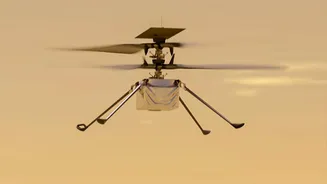
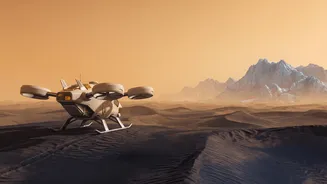
To explore this strange and varied world, a simple rover won't do. NASA's solution is Dragonfly, a car-sized, nuclear-powered octocopter—a drone with eight rotors. Scheduled to launch in July 2028, Dragonfly will take about six years to reach Titan, arriving in 2034. Flight is surprisingly well-suited for Titan; its thick atmosphere and low gravity mean the rotorcraft can easily travel vast distances. This mobility is key. Dragonfly won't be stuck in one place. It will fly from one site to another, making leaps of several kilometers at a time to sample diverse geological settings, from organic sand dunes to the floor of an impact crater. The mission is designed to last for over three years, hopping between dozens of promising locations.
The Search for Life's Ingredients
Dragonfly isn't looking for little green men; it’s searching for the building blocks of life. Its primary goal is to study prebiotic chemistry—the complex chemical reactions that may have occurred on Earth before life began. Titan is considered a planetary-scale laboratory for these processes. Its atmosphere is rich in nitrogen and methane, which, when zapped by sunlight, create a smog of complex organic molecules that rain down onto the surface. Dragonfly is equipped with a sophisticated suite of instruments to analyze this material. Its mass spectrometer (DraMS) and drill (DrACO) will allow it to sample and identify the chemical compounds on the surface. Another instrument, the Dragonfly Gamma-Ray and Neutron Spectrometer (DraGNS), will measure the composition of the ground beneath the lander, searching for key elements like carbon, hydrogen, nitrogen, and oxygen.
An Ancient Watery World?
One of Dragonfly's most compelling targets is the Selk impact crater. Scientists believe the energy from the asteroid impact that created this crater would have melted the local water ice, creating a temporary pool of liquid water that could have mixed with the abundant organic molecules on the surface. This mixture of liquid water and complex organics, even if it only lasted for hundreds or thousands of years, could have created a localized 'primordial soup'—a potential cradle for the chemistry of life. By drilling into the deposits at Selk crater, Dragonfly could find evidence of these past chemical reactions, offering unprecedented insights into whether a world as cold and alien as Titan could have once possessed habitable environments. The mission will land in a dune field named Ahmakiq Undae, near the crater, giving it access to both the crater's melt deposits and the surrounding organic-rich dunes.