





The Grand Road Awakens
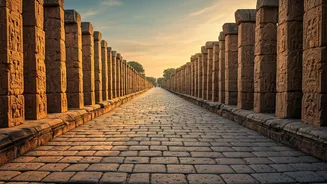
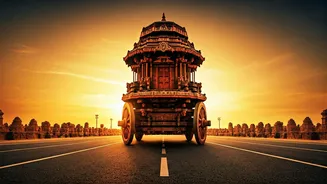
For most of the year, the Bada Danda in Puri is a wide, bustling thoroughfare connecting the 12th-century Jagannath Temple to the Gundicha Temple. But for one day, during the annual Ratha Yatra, it transforms. The three-kilometre stretch ceases to be
a mere road; it becomes a sacred pathway, a theatre of devotion, and a witness to one of the world's most incredible spiritual gatherings. Millions of people—devotees, volunteers, and curious onlookers—converge here, their individual identities merging into a single, pulsating entity. The air, thick with humidity and anticipation, crackles with an energy that is at once chaotic and deeply harmonious. This is the stage upon which the Lord of the Universe, Jagannath, makes his annual journey, and for anyone standing amidst the crowd, the sheer scale is the first and most overwhelming spiritual view.
Moving Temples of Faith
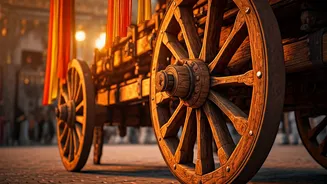
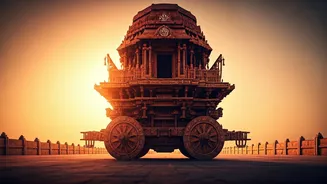
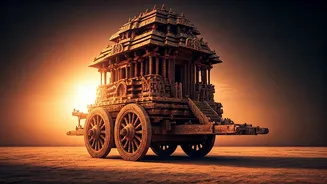
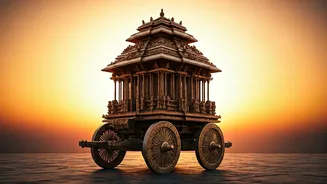
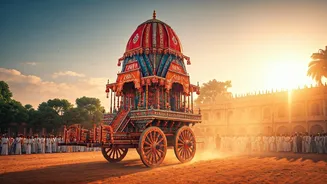
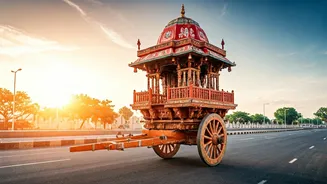
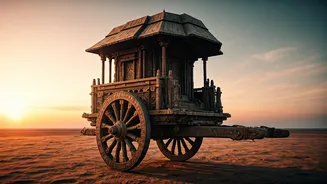
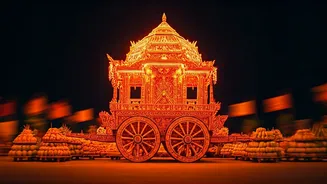
The protagonists of this divine drama are the three colossal chariots. Towering over the crowd like mobile temples, they are constructed anew each year by traditional artisans. Lord Jagannath’s chariot, Nandighosha, stands over 44 feet tall, draped in vibrant red and yellow cloth. Lord Balabhadra’s Taladhwaja, with its red and green covering, and Devi Subhadra’s Darpadalana, in red and black, follow in majestic succession. These are not mere vehicles; they are marvels of sacred engineering and artistry. For today's youth, accustomed to digital perfection, the raw, tangible grandeur of these chariots offers a different kind of awe. Seeing thousands of hands grasping the thick coir ropes to pull the immense structures forward is a powerful lesson in collective effort and shared faith. Each lurch of the wooden wheels, each cheer from the crowd, reinforces the idea that faith can, quite literally, move mountains.
A Symphony of Devotion
The Ratha Yatra is an experience for all senses, but it is the sound that truly defines it. The procession moves to a symphony of faith. The resonant call of conch shells cuts through the air, answered by the rhythmic clang of cymbals (kartalas) and the deep, booming beat of traditional drums (mardalas). Groups of devotees, lost in ecstatic dance, lead kirtans, their voices rising and falling in a collective chant of 'Jai Jagannath!' This sonic tapestry is more than just noise; it's a form of prayer, a collective expression of joy and devotion that transcends language. For a younger generation often plugged into personal audio devices, being enveloped by this all-encompassing, shared soundscape can be a profoundly unifying and grounding experience, a reminder of the power of community and shared celebration.
Where Tradition Meets the Now
While the rituals are ancient, the experience is intensely contemporary. The headline's focus on youth is not misplaced. Young people flock to Puri not just out of familial obligation but out of a genuine desire to connect and participate. They document the spectacle on their smartphones, sharing live videos and vibrant photos, becoming modern-day storytellers of an age-old tradition. This act of sharing is not a distraction; it's an integration. It's a way of saying, 'This is my heritage, and it is alive and relevant today.' The festival offers a unique blend of spiritual solemnity and celebratory fervour. It is a space where one can be deeply introspective in one moment and caught up in a joyous, public celebration the next. This duality—the personal and the communal, the ancient and the instant—is what makes the Ratha Yatra so compelling for a generation that navigates multiple identities with ease.
The Ultimate Darshan
Ultimately, the 'breathtaking spiritual views' are not just about what one sees with the eyes. They are about the feeling of 'darshan'—the act of seeing and being seen by the divine. The philosophy behind Ratha Yatra is beautifully inclusive: the deities leave the sanctum sanctorum of the temple to give their audience to everyone, irrespective of caste, creed, or religion. On the Grand Road, divinity is not confined behind stone walls; it is accessible, mobile, and amidst the people. For many, catching a glimpse of the deities on their chariots, even from a distance, is a deeply emotional and transformative moment. It is this feeling of direct connection, of being part of a divine journey, that forms the spiritual core of the festival and leaves an indelible mark on the soul, long after the crowds have dispersed and the Grand Road returns to its everyday purpose.