





More Than Just a Test Flight
The primary goal of Artemis II was to test the Orion spacecraft and its life support systems with a human crew on board, paving the way for future lunar landings. But the mission, which sent astronauts Reid Wiseman, Victor Glover, Christina Koch, and Jeremy
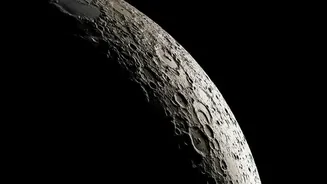
Hansen on a 10-day trip around the Moon, was also a golden opportunity for science. For the first time since the Apollo era, trained human observers were able to document the Moon up close, and their observations have provided a wealth of new information. This week, NASA released a 130-page preliminary report, along with over 800 gigabytes of images, audio, and notes from the crew. It's the first major planetary science dataset in half a century to be shaped primarily by direct human observation.
Sparks on the Lunar Surface
One of the most exciting findings was the crew's direct observation of meteoroid impacts on the Moon's surface. During a period when the Moon eclipsed the Sun from their perspective, the astronauts witnessed at least five distinct 'flashes' on the unlit portion of the lunar surface. Commander Reid Wiseman was the first to spot one, calling it out to Mission Control. Crewmate Jeremy Hansen described another as a simple 'bloop' of light. Because the Moon has virtually no atmosphere, these impacts don't create fire; instead, the flash is a momentary glow from the rock and lunar surface being instantly vaporized by pure kinetic energy. Scientists believe these flashes were caused by rocks no bigger than a walnut, making them likely the faintest impact flashes ever seen by the human eye. This data is crucial for assessing the risk that even tiny meteoroids pose to future lunar bases and astronauts.
The Moon's Surprising Colors
While we see the Moon as a canvas of white and gray, the Artemis II crew reported a much richer and more surprising palette. As they flew over the Aristarchus Plateau, a geologically diverse region, the astronauts described seeing streaks of 'jaundiced yellow', 'swampy green', and brown. These were not camera artifacts; they were colors witnessed with the naked eye. Mission Specialist Christina Koch called the region 'a jaundiced cheek of the Moon'. Scientists believe these hues could be linked to volcanic glass beads rich in minerals like titanium (orange/yellow) and magnesium (green), similar to samples brought back by the Apollo missions. The crew's ability to describe these colors in real-time provides a level of detail and context that automated probes often miss, highlighting the unique value of human explorers.
A Stepping Stone for What's Next
Beyond the unexpected colors and impact flashes, the mission was a resounding success in its core scientific objectives. The crew participated in multiple experiments to study how deep space affects the human body, from immune system changes to the psychological stresses of long-duration missions. This health data is vital for planning the upcoming Artemis III mission, which will land astronauts on the lunar surface, and for eventual journeys to Mars. The massive dataset—from high-resolution photos to the astronauts' handwritten notes—has been released to the public and the global scientific community. This 'passing of the baton' allows researchers everywhere to dig into the findings and build upon the crew's historic journey.