



A New Window on Distant Worlds
For decades, finding planets outside our solar system, or exoplanets, has shifted from science fiction to a concrete scientific pursuit. We now know of thousands, but knowing they exist is different from knowing what they are. This is especially true
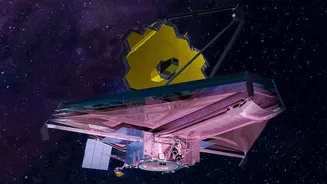
for rocky planets similar in size to Earth. The James Webb Space Telescope represents a quantum leap in our ability to study these worlds. By observing in infrared light, JWST can detect the faint heat emitted by these distant planets and analyse the chemical composition of any potential atmosphere, a technique that was previously difficult or impossible for smaller, rocky worlds.
The Challenge of Finding Atmospheres
Detecting an atmosphere around a small, rocky exoplanet is one of the biggest challenges in modern astronomy. Unlike gas giants, which have thick, puffy atmospheres, a rocky planet's gaseous envelope can be incredibly thin and difficult to spot. Before JWST, observations of rocky worlds often came back with frustratingly ambiguous results. Scientists couldn't definitively tell if a planet had a thin atmosphere or was just a bare rock. This is because the signal is minuscule, often overwhelmed by the light of the planet's host star. JWST's incredible sensitivity is finally breaking through this barrier, giving us our first real look at the air surrounding these alien Earths.
Breakthrough on a Lava World
One of the most compelling recent findings comes from the super-Earth 55 Cancri e, located 41 light-years away. This planet orbits so close to its star that its surface is likely a molten ocean of magma. Using JWST, researchers have found the best evidence to date for a substantial atmosphere on a rocky planet. The data, gathered by measuring the planet's thermal emission, suggests the presence of a thick atmosphere, potentially rich in carbon monoxide and carbon dioxide. This atmosphere is believed to be 'secondary,' meaning it is being replenished by gases released from the planet's molten interior, a process known as outgassing. The dayside temperature was measured at around 1540 degrees Celsius, which is actually cooler than expected for a bare rock, suggesting an atmosphere is distributing heat.
The Power of Spectroscopy
The key to these discoveries is a technique called spectroscopy. When a planet passes in front of its star, a tiny fraction of the starlight filters through the planet's atmosphere. Different gases absorb light at specific wavelengths, leaving a unique chemical fingerprint or 'barcode' in the light that reaches the telescope. By analysing this spectrum, astronomers can identify the molecules present, such as carbon dioxide, water vapour, or methane. For planets like 55 Cancri e, JWST also uses its Mid-Infrared Instrument (MIRI) to measure the light emitted directly from the planet as it passes behind its star. This reveals the planet's temperature and gives further clues about its atmospheric properties.
Beyond a Single Planet
The findings for 55 Cancri e are not an isolated event. JWST is systematically studying a variety of rocky worlds, including those in the famous TRAPPIST-1 system. While initial observations of the innermost TRAPPIST planets suggest they may be bare rock with little to no atmosphere, studies are ongoing for worlds further out in the system's habitable zone. For TRAPPIST-1 e, which orbits in the 'Goldilocks zone' where liquid water could exist, JWST has already ruled out a thick, hydrogen-dominated atmosphere. The current data is still being analysed, but it hints at the possibility of a heavier, nitrogen-rich atmosphere, though more observations are needed to be certain. Each observation, whether it finds an atmosphere or not, provides crucial data points for understanding how rocky planets form and evolve.
The Search for a Second Earth
Ultimately, these studies are all steps toward one of humanity's most profound questions: Are we alone in the universe? The ability to detect and characterise atmospheres around Earth-sized planets is fundamental to the search for life elsewhere. An atmosphere can regulate a planet's temperature, shield it from harmful radiation, and provide the necessary pressure for liquid water to exist on its surface. By understanding the variety of atmospheres on rocky planets, from the hellish environment of 55 Cancri e to the potential air of TRAPPIST-1 e, scientists are building a library of planetary possibilities. This knowledge helps refine where to look and what to look for in the ongoing search for a truly Earth-like world with signs of life.