




The Universe's Standard Blueprint
For decades, astronomers have worked with a standard model for how the universe grew up. The theory, known as the Lambda-CDM model, suggests that the first galaxies were small, chaotic, and messy. Over billions of years, these small galaxies would collide
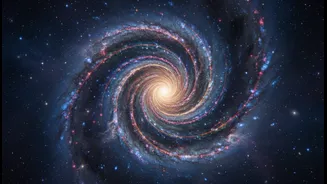
and merge, slowly and gradually forming the large, well-structured galaxies we see today, like our own spiral-shaped Milky Way. This bottom-up process was thought to be a slow, cosmic evolution. Under this model, seeing a complex, mature-looking galaxy in the early universe would be like finding a fully grown adult in a nursery – it simply shouldn't happen.
A Surprise from Cosmic Dawn
JWST’s powerful infrared vision allows it to see light from the universe's infancy. Recently, astronomers from Durham University pointed the telescope at a galaxy as it existed just 4.5 billion years after the Big Bang. What they found was stunning: a galaxy with a complex, dense, and rotating disc of stars at its very center, known as a nuclear disc. These structures are common in nearby, modern galaxies but were thought to take billions of years to form. This discovery shows that complex internal structures were already taking shape when the universe was still in its youth, much earlier than scientists had assumed.
Built by a Cosmic Engine
Even more surprising was how this structure was being built. The observations revealed clear evidence of a long, bar-shaped structure of stars stretching across the galaxy. In modern galaxies, these stellar bars act like cosmic conveyor belts, funnelling gas and stars toward the galactic center and fuelling the growth of structures like nuclear discs. Finding such a bar actively building a disc so early in cosmic history provides direct evidence that some galaxies were evolving in a structured and efficient way just a few billion years after the Big Bang. This suggests a much faster and more organised path to maturity than previously believed.
More Than Just One Anomaly
This isn't an isolated finding. Other JWST observations have consistently found early galaxies that are brighter, larger, and more chemically mature than expected. Some studies have found large populations of "dead" or quiescent galaxies that have already stopped forming stars much earlier than predicted. Others have identified a surprising number of galaxies with flattened, oblong shapes, contrasting with the spherical and spiral galaxies common today. Another puzzle comes from objects nicknamed "little red dots," which at first seemed like impossibly massive and compact galaxies. New interpretations suggest they might be a new type of object entirely: rapidly growing black holes shrouded in such a dense cocoon of gas that they glow like stars. All these discoveries paint a picture of the early universe as a place where things happened much, much faster than our models accounted for.
Rewriting the Cosmic Story
These findings don't break the Big Bang theory, but they do force a major rethink of the astrophysics that followed. The presence of such mature structures so early on challenges the timeline of cosmic growth that has guided astronomy for years. Scientists must now revise their models to account for this rapid development. Was there a different mechanism for galaxy formation at play? Did the first stars and black holes grow more efficiently than we thought? Researchers are now planning follow-up observations to study the movement of gas and stars within these early systems to better understand how they grew so fast. These surprising patterns show that the universe's first billion years were far more dynamic and structured than we ever imagined.