






A New Era for Orbital Outposts
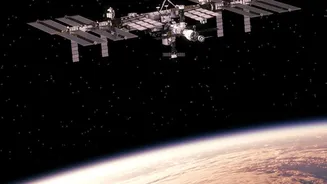
For over two decades, the International Space Station (ISS) has been humanity's lone outpost in low-Earth orbit. But the legendary station is aging, and NASA plans to deorbit it around 2030. Instead of building another government-owned station, NASA is turning
to the private sector, fostering a new commercial market through its Commercial Low-Earth Orbit Destinations (CLD) program. This has ignited a race between companies like Sierra Space, Axiom Space, and others to design, build, and launch the first commercially operated space stations. Their goal is to provide a platform for research, manufacturing, and even tourism, with NASA as a key customer, not the landlord. The transition marks a pivotal shift, aiming to create a robust economy in orbit long after the ISS is gone.
More Than Just a Balloon
When you hear "inflatable," you might think of a party decoration, but these habitats are anything but flimsy. They are sophisticated, multi-layered structures built from high-strength, soft materials like Vectran, a fabric similar to Kevlar. These layers are designed to serve different functions: an inner bladder to hold air, a structural restraint to bear the load, and robust outer layers to protect against the harsh environment of space. This shielding is engineered to withstand impacts from micrometeoroids and orbital debris (MMOD)—tiny particles traveling at extreme speeds—as well as the intense radiation found outside Earth's atmosphere. A key proof-of-concept, the Bigelow Expandable Activity Module (BEAM), has been attached to the ISS since 2016, demonstrating the viability of this technology.
The Compelling Case: More Space, Less Cost
The primary advantage of inflatable modules comes down to launch-day physics. A traditional rigid module, like those on the ISS, is incredibly heavy and takes up its full volume inside a rocket fairing. In contrast, an inflatable habitat can be packed down to a fraction of its size for launch. This significantly reduces its mass and volume, making it much cheaper and easier to get into orbit. Once deployed, the module expands to its full size, providing a vast interior space. Sierra Space's LIFE habitat, for example, is designed to provide roughly one-third of the entire pressurised volume of the ISS in a single module. This efficiency—launching small and living large—is the game-changing factor that makes large-scale commercial space stations economically feasible.
The Companies Inflating Ambitions
Several key players are leading the charge. Sierra Space has been making headlines with its Large Integrated Flexible Environment (LIFE) habitat. The company has conducted several successful burst-pressure tests on prototypes, inflating them to destruction to prove they exceed NASA's safety requirements. A test flight of a pathfinder LIFE module is proposed for as early as late 2026. Meanwhile, Axiom Space is building its own commercial station, which will initially attach to the ISS before becoming a free-flying outpost. While its initial modules are rigid, Axiom also plans to manufacture an inflatable module for media and entertainment purposes, demonstrating the versatility of the technology. Other companies, like Max Space, are also developing their own expandable habitat designs, signalling a broad industry shift.
A Laboratory for Groundbreaking Research
This massive expansion of orbital real estate isn't just for creating more living quarters. The primary purpose is to enable a new wave of research and in-space manufacturing that can only happen in a microgravity environment. These larger facilities will serve as advanced laboratories for breakthroughs in fields like biomedicine, materials science, and technology. Scientists can conduct experiments in drug development, protein crystallisation, and even 3D-print human organs without the constraints of gravity. In-space manufacturing of items like flawless fibre-optic cables or unique semiconductor crystals could revolutionise industries back on Earth. The increased volume offered by inflatable modules will finally provide the space needed to scale these activities from small experiments to commercial production.