


Seeing the Universe in a New Light
When we look at the night sky, we are only seeing a fraction of the story. Our eyes detect visible light, but that’s a very narrow slice of the full electromagnetic spectrum. Infrared light, which we feel as heat, has longer wavelengths than visible light.
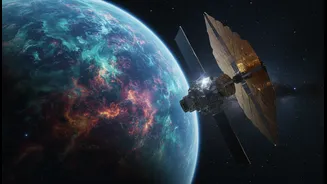
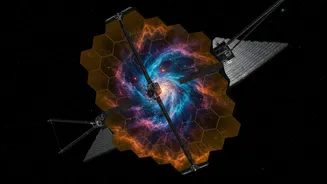
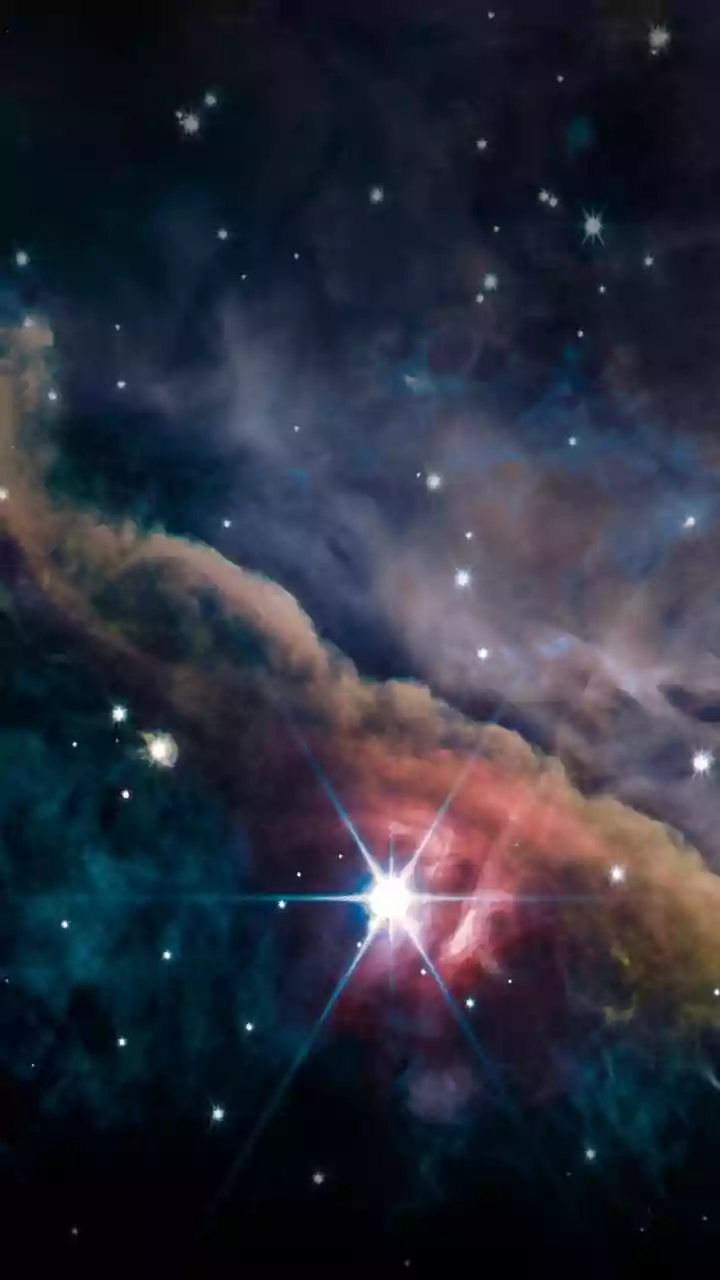
This simple difference is profound for astronomers. While visible light is easily blocked and scattered by clouds of cosmic dust, the longer wavelengths of infrared light can pass right through. This gives telescopes designed to see in infrared, like the James Webb Space Telescope (JWST), a kind of cosmic x-ray vision, allowing them to peer into regions of space that are completely opaque to traditional optical telescopes.
Piercing Through Cosmic Nurseries
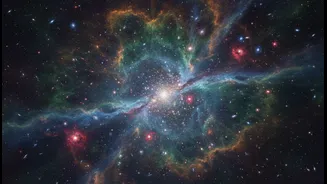
Some of the most fascinating places in the universe are stellar nurseries, vast clouds of gas and dust where new stars and planets are born. However, that same dust makes them impossible to observe in detail with visible light. It’s like trying to see what’s happening inside a thick cloud of smoke. Infrared astronomy changes the game completely. By detecting the heat signatures of young, forming protostars and the glow of the surrounding dust, astronomers can witness the birth of solar systems. Instruments like those on the JWST can cut through the dusty veil, revealing the complex processes that lead to the creation of stars and the planets that will one day orbit them.
Gazing Back to the Dawn of Time
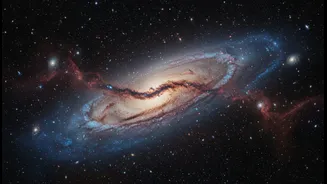
One of the most mind-bending aspects of astronomy is that looking at distant objects is also looking back in time. Because of the constant expansion of the universe, light from the most ancient and distant galaxies gets stretched as it travels across space. This phenomenon, known as 'cosmological redshift', shifts the light from the earliest stars from visible and ultraviolet wavelengths into the infrared spectrum. This means that optical telescopes simply cannot see them. Infrared telescopes, however, are perfectly tuned to capture this ancient light, giving us a direct view of the first galaxies taking shape just a few hundred million years after the Big Bang. It’s the closest we’ve ever come to seeing the universe's baby pictures.
Analysing the Air of Alien Worlds
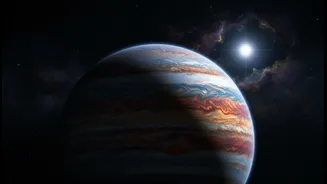
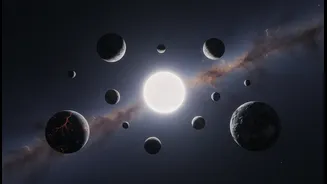
The search for life beyond Earth is one of science's most compelling goals. A key part of this search involves studying the atmospheres of exoplanets—planets orbiting other stars. When an exoplanet passes in front of its star, a tiny fraction of the starlight filters through its atmosphere. Different molecules in the atmosphere, such as water, methane, and carbon dioxide, absorb specific wavelengths of light. Infrared spectrographs are exceptionally good at detecting these molecular fingerprints. By analysing which infrared wavelengths are missing from the starlight, scientists can determine the chemical makeup of an alien world's air, searching for the tell-tale signs of a potentially habitable environment.