



So, What Is Everyone Talking About?
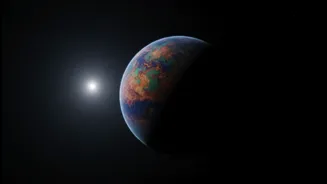
When scientists talk about 'alien weather,' they're referring to the atmospheric conditions on exoplanets—planets that orbit stars other than our own Sun. For a long time, these distant worlds were just blips of data, faint signals suggesting a planet was
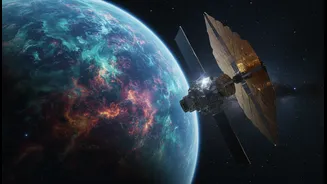
there. But with powerful new instruments, especially space telescopes like Hubble and the James Webb Space Telescope (JWST), we are moving beyond just detecting these planets to actually characterizing what they’re like. The discoveries have been mind-bending, revealing climates so extreme they challenge our understanding of how planets work. The term 'weather' feels almost too gentle for the violent, exotic phenomena being observed light-years away. It’s less about whether you need an umbrella and more about whether that umbrella would instantly vaporize.
Not Your Average Forecast
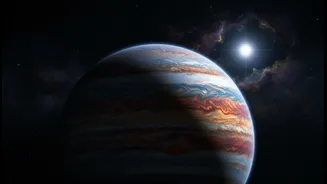
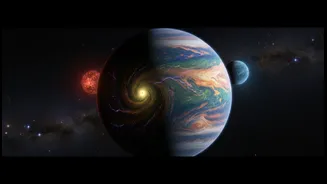
Forget rain or snow. On exoplanet HD 189733b, a gas giant about 63 light-years away, it likely rains molten glass—sideways. This deep blue planet gets its color not from oceans, but from an atmosphere laced with silicate particles. Blistering temperatures of over 1,000 degrees Celsius and winds howling at 7,000 kilometers per hour whip these glass particles across the planet. Then there’s WASP-76b, an 'ultra-hot Jupiter' where the weather forecast includes iron rain. This planet is tidally locked, meaning one side permanently faces its star, roasting at temperatures above 2,400 degrees Celsius—hot enough to vaporize metals like iron. These powerful winds, reaching speeds of 18,000 km/h, then carry the iron vapor to the cooler, perpetually dark side, where it condenses and falls as droplets of molten iron. Other worlds may have clouds of rubies and sapphires or atmospheres on lava planets that are directly tied to a molten surface.
How Do We Know This Stuff?
Astronomers can't exactly send a weather balloon to a planet hundreds of light-years away. Instead, they use a clever technique called transit spectroscopy. When an exoplanet passes in front of its host star from our point of view, a tiny fraction of the starlight filters through the planet's atmosphere. Telescopes like the JWST can analyze this light, breaking it down into its component colors, or spectrum. Different gases and elements in the atmosphere absorb specific colors of light, leaving behind a unique chemical fingerprint. By studying which colors are missing, scientists can deduce what the atmosphere is made of, its temperature, and even the presence of clouds. Recent observations have become so precise that astronomers can now even detect differences in the atmosphere between a planet's morning and evening sides.
More Than Just Weird Weather
While the idea of glass rain and iron clouds is captivating, studying these extreme climates serves a deeper scientific purpose. These distant worlds are natural laboratories for testing the limits of atmospheric physics. The models scientists use to understand and predict Earth's climate are built on fundamental principles of physics and chemistry. By applying these models to such extreme and alien conditions, researchers can see where their theories hold up and where they break down. A recent JWST discovery of unexpected water-ice clouds on a nearby giant planet, for example, revealed that many existing atmospheric models were incomplete because they often left clouds out of the equation. Understanding how atmospheres behave under such intense heat and pressure helps refine the tools used to study all planets, including our own, and deepens our understanding of the vast diversity of worlds that exist in the galaxy.