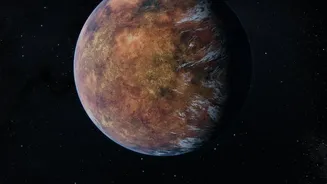


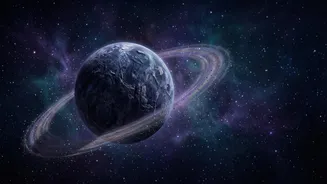

Imagine discovering a new planet, only for it to vanish years later. That’s the cosmic mystery that baffled astronomers for over a decade, but new findings have finally revealed the truth behind the disappearing world of Fomalhaut b.
A Landmark Discovery
In 2008, the world
of astronomy was buzzing with excitement. Using data from the Hubble Space Telescope, scientists announced the discovery of Fomalhaut b, an object orbiting a bright star 25 light-years away. What made this special was that it was one of the very first exoplanets to be 'directly imaged'—seen as a visible moving dot of light. For years, most exoplanets had only been detected indirectly, through their gravitational pull on their stars or the dip in starlight as they passed in front. Seeing a planet, even as a faint speck, was a monumental achievement, offering a new window into distant solar systems.
A Planet Full of Puzzles
From the beginning, Fomalhaut b was a strange case. For a giant planet, it was unusually bright in visible light, yet it gave off almost no heat in the infrared spectrum, which is not typical for a young, massive planet. Astronomers theorised that perhaps the planet was surrounded by a huge ring of dust, which would reflect a lot of light. Its orbit was also highly unusual and appeared to cross a massive, icy debris ring around the star without gravitationally disturbing it, which a large planet should have done. As András Gáspár, an astronomer at the University of Arizona, noted, Fomalhaut b was 'doing things a bona fide planet should not be doing'.
The Vanishing Act
The mystery deepened when astronomers analysed later Hubble images. The object, which was already faint, was fading over time and appeared to be expanding. Then came the final shock: in images taken in 2014, Fomalhaut b was gone. It had completely vanished. Planets, especially massive ones, don't just disappear. This stunning development sent researchers back to the drawing board and confirmed that whatever Hubble had been observing, it was not a stable planet. The 'ghost planet' had left scientists with a fascinating new puzzle to solve.
The Truth: A Cosmic Collision
The solution to the mystery turned out to be even more spectacular than the original discovery. After analysing all the available Hubble data, Gáspár and his colleague George Rieke concluded that Fomalhaut b was never a planet at all. Instead, what Hubble had witnessed was the expanding aftermath of a titanic collision between two massive, icy bodies, each likely around 200 kilometres in diameter. This cosmic smash-up created a huge, expanding cloud of very fine dust. It was this cloud that was so bright in 2004, and as the dust dispersed into space, it faded from view until it became too thin for Hubble to detect. This event was likely a rare one, and astronomers believe they were simply at the right place at the right time to witness its afterglow.
A Blueprint for Planet Formation
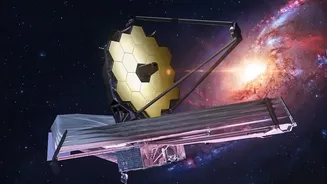
While the loss of a famous exoplanet might seem like a disappointment, the discovery of this massive collision provides invaluable insight into how planetary systems form and evolve. Such collisions are thought to be a common, though rarely seen, part of the planetnd building process. They are chaotic events that can shape the architecture of a solar system. The Fomalhaut system serves as a 'test lab' for these theories, showing a blueprint of how planets can destroy each other and how new bodies form from the resulting debris. The latest observations with the James Webb Space Telescope in 2023 further confirmed the object's nature as a dust cloud, adding more detail to our understanding of this dynamic system. In a strange twist, some of the most recent data from 2023 showed that while the original cloud disappeared, a new bright object has appeared elsewhere in the system, suggesting another, more recent collision has taken place.