


The Life and Times of a Starburst
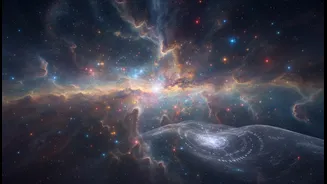
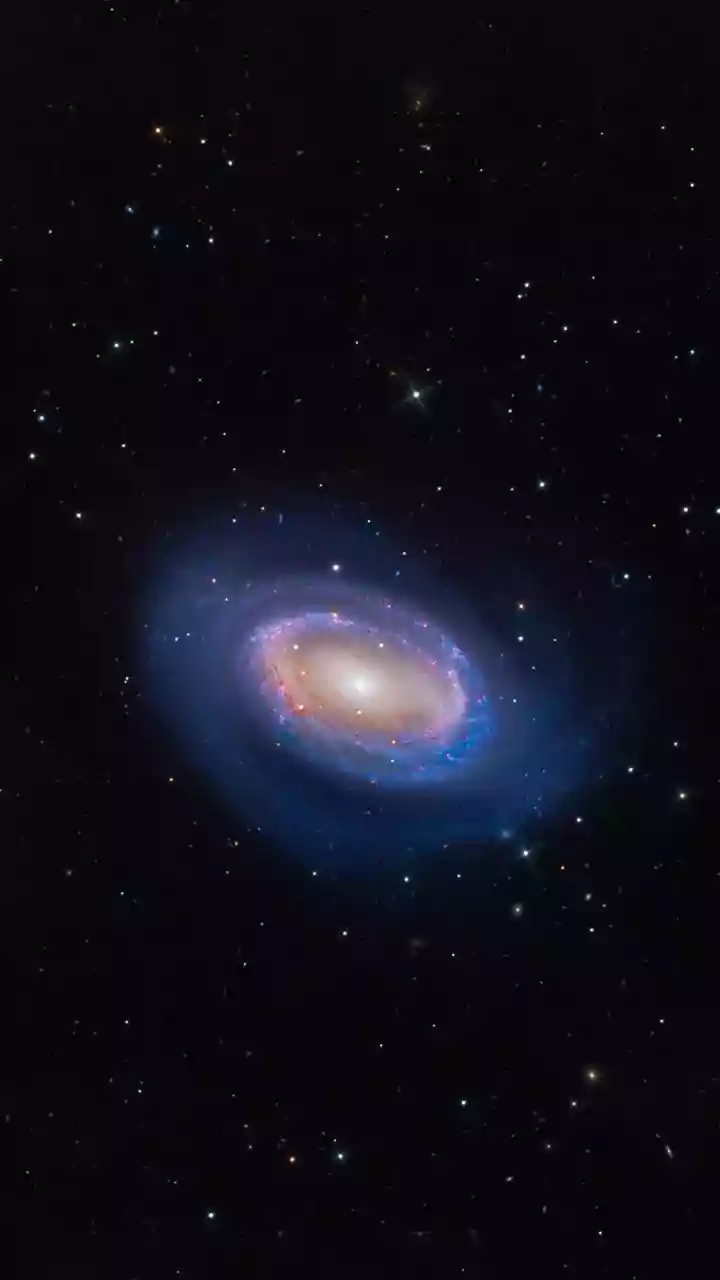
Imagine an entire galaxy forming new stars at a blistering pace, sometimes ten or even a hundred times faster than our own Milky Way. This is a "starburst" galaxy, a celestial factory working in overdrive. This intense period of star formation is a critical
phase in a galaxy's life, shaping its ultimate size and structure. However, these frenetic episodes are unsustainable. They burn through their fuel—vast reservoirs of cold gas—so quickly that they are destined to be short-lived. For decades, astronomers have been puzzled by a related phenomenon: massive galaxies in the early universe that appear to have abruptly stopped forming stars altogether, becoming 'quenched' or 'dead' far earlier than expected. Understanding what slams the brakes on these galactic star factories is a key question in astrophysics.
A Cosmic Tug-of-War
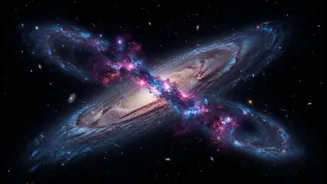
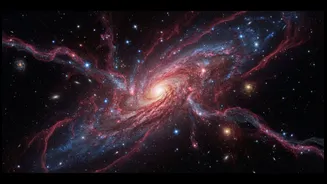
One of the prime suspects behind this sudden shutdown is a process known as galactic tidal stripping. When two galaxies pass close to each other, their immense gravitational fields engage in a destructive tug-of-war. Much like how the Moon’s gravity creates tides in Earth’s oceans, these galactic interactions can pull and warp the structures of the galaxies involved. In more extreme cases, the larger galaxy can literally strip away streams of stars, gas, and dust from its smaller companion. This process can violently disrupt the delicate balance required for star formation. By siphoning away the cold gas needed to create new stars, tidal stripping can effectively starve a galaxy, leading to its slow demise. But recent observations suggest an even more dramatic end is possible.
The Merger and the Shutdown
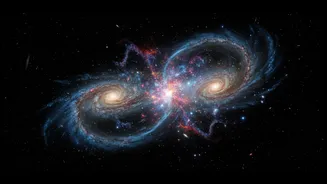
New studies suggest that for the most massive galaxies in the early universe, the quenching process wasn't a gentle fade but a sudden, violent event. The leading theory points to major galactic mergers. When two gas-rich galaxies collide, the impact can initially funnel gas toward the galactic center, triggering a final, massive starburst. However, this chaotic event also has a deadly side effect. The collision can create powerful outflows of gas, driven by the intense radiation from the starburst itself or by the galaxy's central supermassive black hole, which gets a sudden feast of new material. This powerful 'galactic wind' can blast the remaining star-forming gas out of the galaxy entirely, effectively killing any future star production in a cosmically short period.
Webb’s Unprecedented Infrared Vision
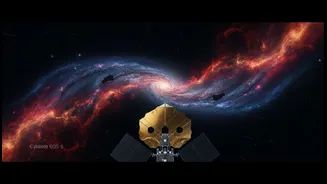
This is where the James Webb Space Telescope (JWST) has become a game-changer. These distant, dramatic events are often shrouded in thick clouds of dust, making them invisible to telescopes that see in visible light, like Hubble. JWST, with its powerful infrared instruments, can peer through this cosmic dust to witness the aftermath of these violent mergers. Recent research using JWST has examined so-called post-starburst galaxies, which are caught just after their star formation has been quenched. While they might look calm on the surface, Webb's sensitive optics can detect faint, residual signs of disturbance—the hidden scars of a past collision. These faint tidal leftovers confirm that a disruptive event, like a merger, was the likely cause of the shutdown.
Rewriting the Story of Galaxies
Thanks to JWST, astronomers are distinguishing between two different paths to galactic death. In the younger, more crowded universe, massive galaxies were often quenched violently by mergers. Their remnants are the compact, spheroidal galaxies we see evidence of today. In the more recent universe, however, a gentler process seems to dominate for less massive galaxies. These systems may have their star-forming gas slowly stripped away by interactions with the hot gas in a galaxy cluster, or they simply exhaust their fuel over time. These observations are helping scientists build a more complete timeline of cosmic evolution. By seeing the faint structural details left behind by these ancient collisions, Webb is not just taking pictures; it's performing galactic archaeology, uncovering the dramatic history of how galaxies like our own came to be.