







More Than Just a 'Bird Brain'
The phrase 'bird brain' used to imply a lack of intelligence, but parrots have forced scientists to rethink that notion entirely. Their talent for vocal mimicry isn't an accident; it's a product of highly specialised brain structures. Research led by
neuroscientist Erich Jarvis at Duke University revealed that parrot brains are unique among vocal-learning birds like songbirds and hummingbirds. Parrots possess a distinct brain pathway for vocalisation, featuring what scientists call a 'core' and a 'shell' system. While other vocal learners have the core, the addition of the shell system is unique to parrots and is believed to be what gives them their superior ability to imitate a wide range of sounds, including the complex tones of human speech.
How Do They Make the Sound?
Unlike humans, who use vocal cords in the larynx to speak, parrots produce sound using a different organ altogether: the syrinx. Located at the base of the trachea where it splits towards the lungs, the syrinx is a highly flexible vocal organ. By controlling the muscles and membranes of the syrinx, along with airflow from their lungs, parrots can generate an astonishing variety of complex sounds. Their thick, muscular tongue also plays a crucial role in shaping these sounds, allowing them to produce the vowels and consonants that make their speech sound so uncannily human. This intricate biological toolkit is the hardware behind their impressive software.
The Masters of Mimicry
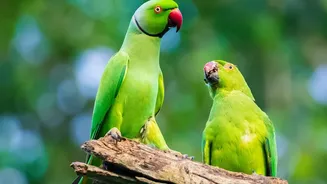
While many parrot species can learn a few words, some are true virtuosos. The African Grey Parrot is widely considered the undisputed champion of talking birds, known not just for a vast vocabulary but also for using words in context. Amazon parrots, particularly the Yellow-naped and Blue-fronted varieties, are also famed for their vocal clarity and even their ability to sing. Other skilled speakers include the talkative Indian Ringneck Parakeet, the clever Quaker Parrot, and even the small-but-mighty Budgerigar, one of which holds a world record for a vocabulary of over 1,700 words.
Why Do They Bother to Talk?
A parrot's motivation to mimic is deeply social. In the wild, parrots are flock animals that use complex calls to communicate, bond, and signal their membership in a group. A single parrot is vulnerable, so fitting in is a matter of survival. When a parrot lives in a human home, its human family becomes its flock. The drive to fit in and bond compels the parrot to learn the 'language' of its new family—which includes human speech, but also the doorbell, the microwave beep, and the ring of a mobile phone. They mimic the sounds that are socially important in their environment to strengthen their bond with their human companions.
Is Anyone Home? Understanding and Intent
The million-rupee question is whether parrots truly understand what they are saying. For a long time, their speech was dismissed as mere 'parroting'—mindless imitation. However, decades of research, most famously by Dr. Irene Pepperberg with her African Grey, Alex, have challenged this view. Alex could identify over 50 objects, seven colours, five shapes, and quantities up to six. He could even combine words creatively, like calling an apple a 'banerry' (a mix of banana and cherry). While not all parrots reach Alex's level, his work proved that parrots are capable of more than mimicry; they can grasp concepts and use language with intent. His last words to Dr. Pepperberg were, 'You be good. I love you. See you tomorrow'.