




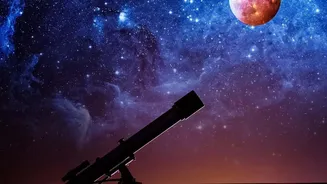
What Makes the Hunter's Moon Special?
The Hunter's Moon isn't a different celestial body; it's simply the traditional name for the first full moon after the Harvest Moon—the one closest to the autumn equinox. Historically, its bright, lingering light was said to help hunters track prey after sunset
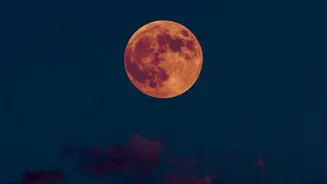
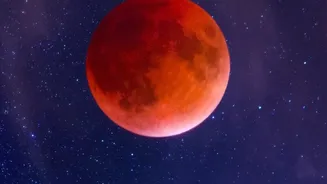
as they prepared for the coming winter. What makes both the Harvest and Hunter's moons unique is their behaviour around moonrise. For several evenings in a row, the moon rises only about 30 minutes later each night, compared to the usual 50-minute delay. This results in a string of nights with a full-looking moon appearing in the sky right around sunset, providing extended twilight illumination. This low position on the horizon is key to its famous fiery colour, but it's also where our atmosphere begins to play tricks on our eyes.
The Atmosphere's Natural Filter
When the moon is low on the horizon, its light must travel through a much thicker slice of Earth's atmosphere to reach us. This dense layer of air molecules acts like a filter. It's particularly effective at scattering shorter wavelengths of light, like blues and violets. This phenomenon, known as Rayleigh scattering, is the same reason our sky appears blue during the day—the blue light is scattered all across the sky. With the blue light filtered out, the longer wavelengths of red, orange, and yellow pass through more easily, giving the rising or setting moon its characteristic warm, golden hue. This is a purely physical effect; the moon itself isn't changing colour.
How Pollution Changes the View
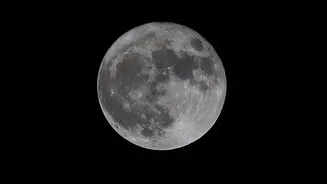
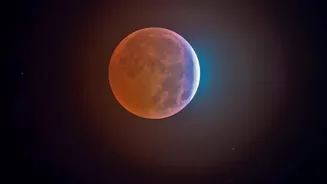
In an ideal, clear sky, the Hunter's Moon would be a sharp, brilliant orange or red near the horizon. But in many urban and suburban areas, air pollution adds another layer to the atmospheric filter. Pollutants like smoke, dust, smog, and other aerosols are composed of particles much larger than air molecules. These larger particles cause a different kind of scattering called Mie scattering. Unlike Rayleigh scattering, which selectively filters out blue light, Mie scattering affects all wavelengths of light more equally. The result is a less vibrant, more washed-out appearance. The moon may look a hazy, dull yellow or even a muted white as its colours are scattered away before reaching our eyes. In areas with heavy smog, the moon can appear dim, blurry, or have its details obscured entirely.
Light Pollution: The Final Factor
Beyond airborne particles, there's another type of pollution that dramatically alters our view: artificial light. Skyglow from cities and towns acts like a luminous veil, reducing the contrast between the moon and the night sky. While the full moon is bright enough to cut through a significant amount of light pollution, its subtler colours are often the first casualty. The deep oranges and reds that make a horizon-hugging moon so spectacular can be drowned out by the glow from streetlights, buildings, and cars. This artificial light scatters in the atmosphere much like moonlight does, creating a bright backdrop that can make the moon itself appear less vivid and its surface details harder to discern. An observer in a dark, rural location will experience a much richer and more colourful moonrise than someone viewing from a brightly lit city centre, even if the air quality is identical.