


The Sun’s Enduring Fever
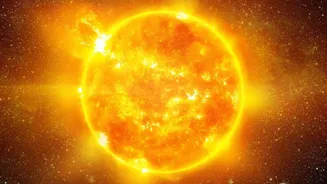
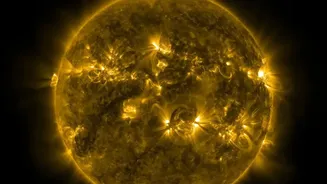
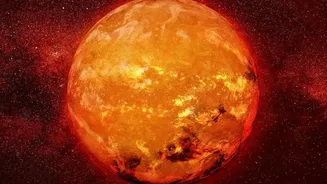
Imagine standing near a bonfire. As you move away, the air gets cooler. This simple logic of physics seems to break down on the Sun. Its visible surface, the photosphere, sizzles at a formidable 5,500 degrees Celsius. But its outer atmosphere, the corona,
which is only visible during a total eclipse, reaches an astonishing temperature of over a million degrees. This is the heart of the “coronal heating problem,” a mystery that has puzzled solar physicists for more than 80 years. How does energy leap from a cooler surface to superheat the atmosphere above it, defying what we know about heat transfer? The answer, it seems, may lie not in a steady furnace but in the constant, violent churning of the Sun's plasma.
A Ripple on the Surface
Recently, scientists got their best look yet at the Sun's turbulent surface, and they saw something new. Using the world's most powerful solar telescope, they observed tiny, swirling vortices of plasma, like microscopic whirlpools in a cosmic ocean. These structures, some measuring only a few dozen kilometres across, are the first direct observation of a phenomenon known as Kelvin-Helmholtz instability on the Sun. This instability occurs when two layers of fluid—or in this case, plasma—slide past each other at different speeds. On Earth, you can see this effect in the way wind creates waves on water. On the Sun, it creates these swirling patterns at the edges of massive, continent-sized convection cells called granules.
Seeing the Unseen
Spotting these tiny tempests was a monumental achievement. The discovery was made possible by the Daniel K. Inouye Solar Telescope in Hawaii, an instrument so powerful it can resolve features on the Sun's surface smaller than the island of Manhattan, all from a distance of 150 million kilometres. The incredible resolution allowed an international team of scientists to see the subtle, wave-like motions at the boundaries of the Sun’s granules, where hotter plasma rises and cooler plasma sinks. These observations confirmed the long-held theory that these instabilities should exist, but until now, telescopes were not sharp enough to actually see them. It was the equivalent of finally being able to see the individual brushstrokes in a masterpiece that had only been viewed from a distance.
Cracking the Solar Code
So, what do these tiny whirlpools have to do with the corona's extreme heat? The Kelvin-Helmholtz instability is a highly effective way to transfer energy. These vortices act like egg beaters, taking the large-scale motion of the Sun's surface and churning it into smaller, more chaotic turbulence. This process can carry vast amounts of energy upward, injecting it into the tenuous plasma of the corona where it is then dissipated as heat. It's a critical clue that could help solve the coronal heating puzzle. Furthermore, understanding these dynamics is not just academic. This energy transfer mechanism is fundamental to the Sun's behaviour, including the build-up of magnetic energy that can lead to solar flares and coronal mass ejections—the massive solar storms that can impact satellites, power grids, and communications here on Earth.