

What Are Solar Storms?
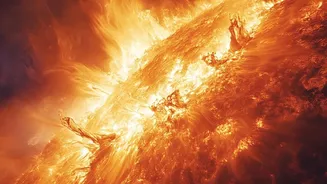
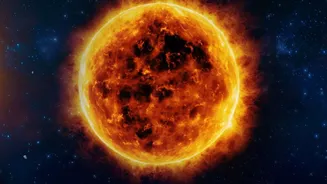
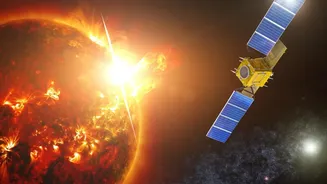
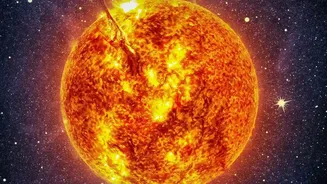
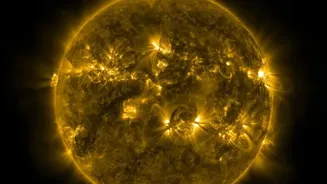
A solar storm is a disturbance on the sun that can send waves of energy and particles into space. The two main types we worry about are solar flares and coronal mass ejections (CMEs). A solar flare is an intense burst of radiation that reaches Earth in about eight
minutes. It can disrupt radio communications. A CME, on the other hand, is a much larger and more powerful eruption, launching billions of tons of plasma and magnetic fields from the sun’s corona. These CMEs travel slower, taking anywhere from 15 hours to several days to reach Earth, but they carry the potential for much more significant disruption.
The Threat to Our Power Grids
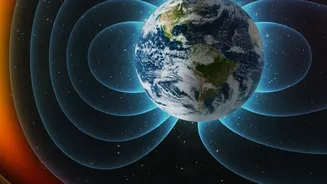
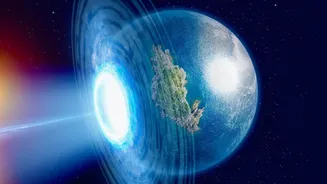
The greatest terrestrial threat from a powerful CME is to our electrical power grids. When a CME slams into Earth's magnetic field, it creates geomagnetically induced currents (GICs) that flow through the ground. These currents can find their way into long-distance power lines, flowing into high-voltage transformers. These transformers are not designed to handle this type of direct current and can overheat, melt, or even explode. A single, powerful storm could potentially damage hundreds of transformers simultaneously, leading to widespread, long-lasting blackouts that could take months or even years to fully repair.
Satellites and Communications Under Siege
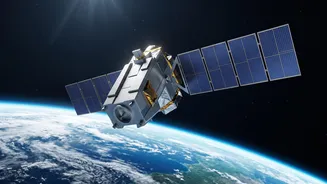
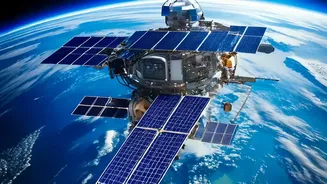
Our modern world runs on satellites. They provide GPS navigation, global communications, weather forecasting, and financial transactions. During a solar storm, these vital assets are highly vulnerable. Energetic particles can damage or destroy sensitive satellite electronics. The storm can also heat and expand Earth's upper atmosphere, increasing drag on low-orbit satellites, causing them to lose altitude and potentially burn up. Furthermore, the disruption to the ionosphere can degrade or block GPS signals and other radio communications, impacting everything from aviation to emergency services.
A Warning from History: The Carrington Event
To understand the worst-case scenario, we look to the past. In 1859, the most powerful geomagnetic storm in recorded history, known as the Carrington Event, struck Earth. The preceding solar flare was so bright it was visible to the naked eye. The resulting CME reached our planet in just 17.6 hours. At the time, the world's most advanced technology was the telegraph. Systems across Europe and North America failed catastrophically, with operators receiving electric shocks and sparks setting telegraph paper on fire. Auroras, normally confined to polar regions, were seen as far south as the tropics. If a storm of this magnitude were to happen today, the impact on our electrified and satellite-dependent society would be catastrophic.
India's Push for Preparedness
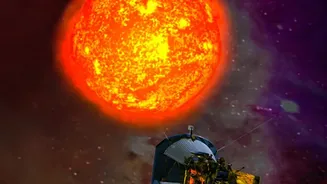
Recognising the threat, scientists in India are at the forefront of space weather research. Teams from the Indian Institute of Astrophysics (IIA) and Aryabhatta Research Institute of Observational Sciences (ARIES) are developing new models to better predict solar eruptions. Recent research has uncovered new insights into the thermal properties of CMEs, potentially providing new warning signs for the most dangerous storms. India’s Aditya-L1 solar mission is expected to play a crucial role in these efforts, allowing scientists to monitor solar activity more closely and refine forecasting models. This research is not just academic; it is a critical component of national resilience, helping to safeguard India's critical infrastructure and growing space and digital economies.