

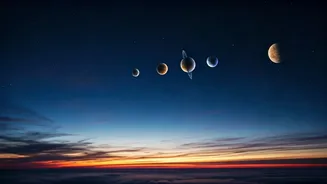
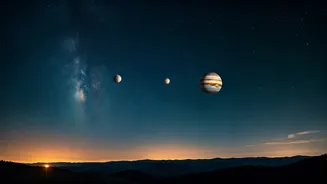


Know Your Targets: The Celestial Trio
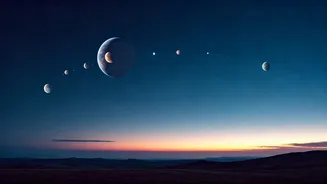
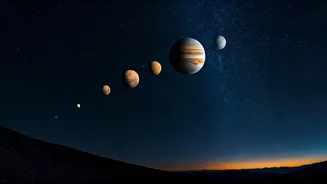
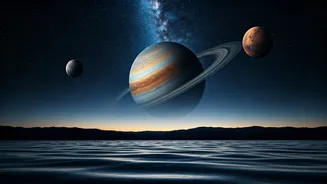
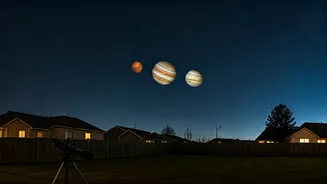
First, let's identify our cast of characters. While planetary alignments vary, a common trio you might see includes Jupiter, Mars, and Saturn. Venus, the brightest of all, often makes an appearance as well. The key is knowing who is who. Jupiter is typically
the second-brightest object in the night sky after the Moon, shining with a brilliant, steady silver light. Mars is famous for its distinct reddish-orange hue, a colour that's easily noticeable even to the naked eye. Saturn will appear as a steady, yellowish-white point of light, not as dazzling as Jupiter but still impressively bright. Unlike the shimmering, chaotic light of stars, planets glow with a constant, solid radiance. This simple difference is your first clue that you're looking at a visitor from our solar system.
Timing Is Everything: When to Look
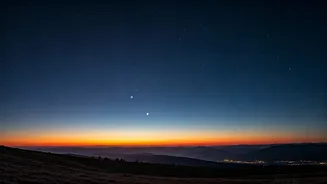
For planetary alignments visible in the evening, the best viewing window is during twilight. Start looking about 30 to 45 minutes after sunset. This is the 'blue hour,' when the sky is dark enough for the planets to pop out, but there’s still enough ambient light to provide a beautiful backdrop. If you look too early, the sun's residual glare will wash them out. If you wait too long, the planets may have already dipped below the horizon. The key is to find that sweet spot as the deep blue of dusk settles in. For morning alignments, the same logic applies in reverse: look about 45 minutes before sunrise. Check a reliable weather app for local sunset or sunrise times to plan your viewing perfectly.
Find Your Stage: Location, Location, Location
You can’t enjoy the show if your view is blocked. Your ideal viewing spot has two main qualities: a clear, unobstructed view of the horizon and minimal light pollution. For evening planets, you’ll typically be looking toward the west or southwest, so find a spot where buildings or tall trees don't obscure that direction. This could be a local park, a sports field, or even an elevated spot like a terrace or a nearby hill. Getting away from the city's glow will make a huge difference. The darker your surroundings, the more celestial objects you’ll see, and the more vibrant the planets will appear. Even moving to a less-lit corner of your neighbourhood can significantly improve your experience.
The Right Gear (Or None at All)
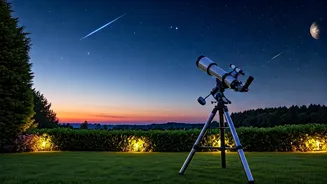
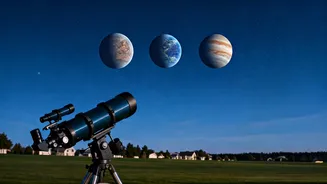
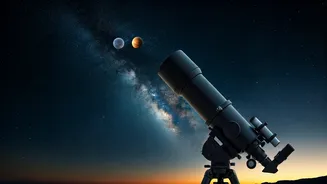
The beauty of watching bright planets is that you don't need any special equipment. These events are fantastic naked-eye spectacles. However, if you have a pair of binoculars, you’re in for a treat. Even standard 7x50 or 10x50 binoculars will transform the planets from bright dots into actual worlds. With Jupiter, a steady hand or a simple tripod might even reveal its four largest moons—Io, Europa, Ganymede, and Callisto—as tiny pinpricks of light flanking the planet. For Saturn, binoculars can hint at its elongated shape, a sign of its famous rings. A small telescope, of course, will take this to the next level, clearly resolving Saturn's rings and Jupiter's cloud bands. But don't let a lack of gear stop you; your eyes are more than enough.
Your Digital Co-Pilot: Use a Sky App
Take the guesswork out of stargazing with a little help from your phone. Free apps like SkyView Lite, Star Walk 2, or Stellarium are game-changers for beginners. These apps use your phone's GPS and compass to create a real-time map of the sky. Just point your phone upwards, and the app will identify the stars, constellations, and—most importantly—the planets you're looking at. You can even use their search function to ask, "Where is Jupiter?" and an arrow will guide you directly to it. It’s an incredibly powerful tool that turns a potentially confusing sky into a familiar, navigable landscape, ensuring you don't miss the main event.