



A Sweet Find Near the Galactic Center
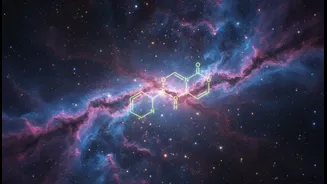
An international team of scientists has announced the first-ever detection of a true sugar molecule in interstellar space. The molecule, called erythrulose, is a four-carbon sugar found in a giant molecular cloud known as G+0.693−0.027, located about
26,745 light-years from Earth. On our planet, erythrulose is found in things like red raspberries. Using powerful radio telescopes in Spain—the Yebes 40-meter and IRAM 30-meter—researchers analyzed the unique radio signals, or spectral lines, emitted by the cloud. They matched these signals to the laboratory fingerprint of erythrulose, confirming its presence in the cold, dusty nursery where stars are born.
More Than Just a Simple Sugar
While simpler organic molecules have been found in space before, this discovery is a significant leap in complexity. Sugars are vital building blocks for life as we know it, forming the structural backbone of DNA and RNA and powering metabolic processes. Previously, sugars like ribose have been identified in meteorites that have landed on Earth, but this is the first time a true sugar has been directly detected in the interstellar medium—the raw material from which stars and planets form. This suggests that the ingredients for life are not just hitching rides on asteroids but are present at the very earliest stages of solar system formation. The discovery challenges old theories and opens up new possibilities about how the chemistry of life gets started.
Challenging a Core Chemical Theory
One of the most surprising aspects of the discovery is the sheer abundance of erythrulose. The team found that the four-carbon sugar is at least eight times more plentiful than any simpler, three-carbon sugars in the same cloud. This finding runs counter to the prevailing theory in astrochemistry, which holds that complex molecules form sequentially, by adding one carbon atom at a time. The abundance of erythrulose suggests a different mechanism might be at play. Researchers now propose that this larger sugar may form from the merging of simpler two-carbon molecules, like alcohols and aldehydes, on the icy surfaces of cosmic dust grains. This insight could reshape scientific models of how complex organic matter is built in the universe.
From Cosmic Clouds to a Young Earth
This discovery strongly supports the theory that key ingredients for life were delivered to Earth from space. Scientists estimate that millions of tons of sugars like erythrulose could have rained down on our planet during the Late Heavy Bombardment, a chaotic period from about 4.1 to 3.8 billion years ago when countless comets and meteorites struck the Earth. This cosmic delivery service could have seeded the young planet with the raw materials necessary for life to emerge. While erythrulose is not a direct component of DNA, it is a close chemical relative and its presence suggests that other, even more critical sugars—like ribose, the 'R' in RNA—could also be forming in these interstellar clouds. The search is now on for these and other prebiotic molecules, bringing us one step closer to understanding our cosmic origins.