



Getting There: Direct and Affordable
The dream of walking the ancient Silk Road is now just a short flight away. Airlines like Uzbekistan Airways and IndiGo are offering direct routes from major Indian cities, including Delhi and Mumbai, to Tashkent. [9, 48] These flights have significantly
cut down travel time, with a direct flight from Delhi taking approximately three to four hours. [34, 37] The term "affordable" is not just a buzzword here; with smart booking, round-trip fares can be found that are competitive with many popular Southeast Asian destinations, making Uzbekistan an excellent value-for-money international getaway. [14, 47, 51] This new accessibility opens up a world of history, culture, and architecture that was previously a multi-stop journey for most Indian travellers.
The Old City's Enduring Charm
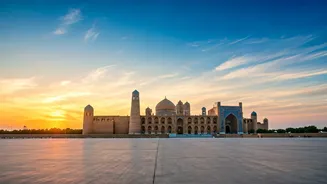
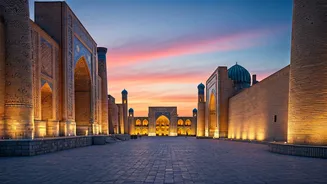
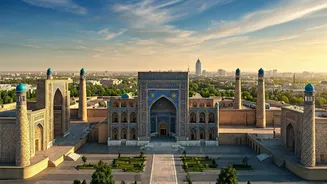
Tashkent’s heart beats strongest in its Old City, a labyrinth of narrow lanes and historic monuments. [28, 52] The centerpiece is the magnificent Khast-Imam Complex, the spiritual hub of Tashkent. [22, 30] This sprawling square features the Barak-Khan Madrasah, Tilla Sheikh Mosque, and the mausoleum of Abu Bakr Kaffal Shashi, a 10th-century Islamic scholar. [12, 31, 40] The complex was significantly restored in 2007, but it retains its historic grandeur. [21, 30] Most notably, the Muyi Mubarak Library within the complex holds what is believed to be the world's oldest surviving Quran, the Uthman Quran, making it a major pilgrimage site. [17, 44] Nearby, the 16th-century Kukeldash Madrasah continues to operate as an Islamic school, standing proudly near the buzz of the city's main bazaar. [15, 28]
Soviet Grandeur and Underground Palaces
Tashkent's story is also one of resilience and reinvention, much of it shaped during the Soviet era after a devastating earthquake in 1966. [27] This period gave the city a unique architectural identity, blending modernist forms with local motifs. The most stunning example of this is not above ground, but below. The Tashkent Metro, the first in Central Asia, is a tourist attraction in its own right. [23, 27] Often called an "underground palace," each station is a unique work of art. [35] The Kosmonavtlar station celebrates Soviet space exploration with futuristic blue-and-black walls and portraits of cosmonauts, while the Alisher Navoiy station is adorned with intricate panels depicting scenes from the famous poet's work. [20, 27, 45] A ride on the metro is a journey through an art gallery, costing just a few rupees. [42]
Chorsu Bazaar: A Feast for the Senses
No trip to Tashkent is complete without a visit to Chorsu Bazaar, one of the oldest and largest markets in Central Asia. [26, 29] For centuries, it has been a bustling hub of commerce and culture at the crossroads of ancient trade routes. [25, 33] Its most recognizable feature is the giant, green-tiled central dome, a 1970s structure that masterfully blends Soviet modernism with traditional Islamic design. [11] Inside, the market is a vibrant explosion of sights, sounds, and smells. You'll find everything from pyramids of spices and mountains of fresh produce to delicious local breads, dried fruits, and nuts. [21] It's not just a place to shop; it's where you can feel the true pulse of the city and taste its authentic flavours.
Planning Your Tashkent Adventure
For Indian citizens, getting to Uzbekistan is straightforward with a simple online e-visa process. [5, 13] You’ll need a valid passport, a photograph, and details of your travel plans. [5, 18] The best times to visit are during the spring (March to May) and autumn (September to November), when the weather is pleasant and ideal for sightseeing. [4, 8, 36] Summers can be extremely hot, while winters are quite cold. [6] The local currency is the Uzbekistani Som (UZS), and while cards are accepted in some hotels and restaurants, cash is king for markets and smaller transactions. [42] The city itself is quite affordable, with budget-friendly options for food, local transport, and accommodation. [10, 32, 49]