






It’s All About the Tilt
The most common misconception about seasons is that summer happens when Earth is closer to the Sun. While our planet's orbit isn't a perfect circle, the distance variation is not the primary driver of our seasons. The real secret lies in our planet's tilt.
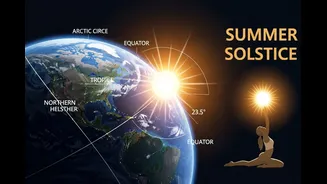
Imagine Earth as a spinning top, tilted on its axis by approximately 23.5 degrees. This tilt is constant as we journey around the Sun. It’s this lean that causes different parts of the globe to receive more direct sunlight at different times of the year. Without this tilt, we wouldn't have distinct seasons; the climate would be largely static, dependent only on latitude. This simple, persistent lean is the foundational piece of the entire solstice puzzle.
A Year-Long Orbital Dance
As our tilted Earth orbits the Sun, the Northern Hemisphere is angled towards the Sun for one half of the year and away from it for the other. When our hemisphere is leaning into the Sun’s rays, the sunlight hits us more directly, like a flashlight shining straight down. This concentrated energy heats the surface more efficiently, giving us summer. The Summer Solstice marks the exact moment of maximum tilt towards the Sun. Conversely, six months later, when we are tilted away, the sunlight strikes at a shallower angle, spreading the energy over a larger area and bringing the chill of winter. This constant dance between our planet’s orientation and its position in orbit is the engine of our seasons.
The Sun's Highest Point
The word 'solstice' comes from the Latin 'sol' (sun) and 'stitium' (to stand still). Ancient observers noted that the Sun's path across the sky, which rises higher each day from winter to summer, seems to halt its northward climb on this day before starting its journey south again. Geometrically, the Summer Solstice is the moment the Sun reaches its northernmost point in the sky, appearing directly overhead at the Tropic of Cancer (a latitude of 23.5° North). For everyone living in the Northern Hemisphere, this translates into the longest period of daylight for the entire year. The Sun takes its longest, highest arc across the sky, resulting in an early dawn and a late dusk.
Ancient Geometry in Action
This understanding of celestial geometry isn’t new. For millennia, cultures across the world have observed this pattern and embedded it into their architecture and rituals. The most famous example is Stonehenge in England, where the stones are aligned to frame the sunrise on the Summer Solstice. But we have incredible examples right here in India. The Jantar Mantar observatories in Delhi and Jaipur are collections of massive astronomical instruments built in the 18th century. Instruments like the Samrat Yantra, essentially a giant sundial, were designed to track the Sun's position with incredible accuracy, allowing for precise measurement of the moment of the solstice. These structures are a testament to a deep, ancient understanding of the geometric relationship between Earth and Sun.
What It Means for Us in India
As a country located entirely within the Northern Hemisphere, all of India experiences the Summer Solstice. However, the effect is more pronounced the further north you go. On June 21, a city like Leh in Ladakh will experience a significantly longer day than Kanyakumari at the southern tip of the subcontinent. This is because Leh is much farther from the equator and closer to the northern latitudes where the effect of the Earth's tilt is more extreme during the solstice. While the whole country enjoys extended daylight, the precise duration varies, painting a beautiful geographical picture of how this cosmic event plays out across our diverse landscape.