




A Brief Refresher on Warped Space
To understand this cosmic detective story, we first need to revisit one of science's most famous concepts. In 1915, Albert Einstein proposed that space and time are not a static backdrop but a single, interwoven fabric: space-time. His theory of general
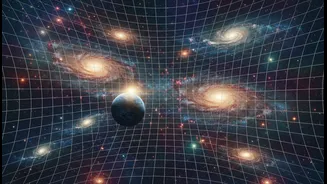
relativity states that massive objects, like stars and planets, don't just sit in this fabric; they warp it, creating curves and dimples. Think of a bowling ball placed on a trampoline. It creates a dip, and any smaller marbles rolled nearby will curve towards it. This curvature is what we experience as gravity. For decades, this idea explained the orbits of planets and the bending of starlight, but its latest application is something even Einstein might have found astonishing.
The Challenge of Finding Distant Worlds
Exoplanets—planets orbiting stars other than our Sun—are incredibly difficult to find. They are tremendously far away and fantastically dim compared to the glare of their parent stars. The most common detection method, known as the transit method, involves watching for a tiny dip in a star's light as a planet passes in front of it. While successful, this method is best at finding large planets that orbit very close to their star. This leaves a huge number of potential worlds—smaller, more distant, or even free-floating planets without a star—largely invisible to us. That is, until astronomers started using gravity itself as a telescope.
Gravity's Own Magnifying Glass
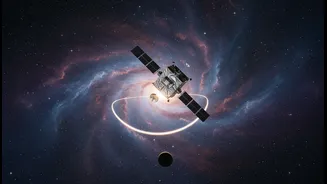
This is where Einstein's theory gets a 21st-century upgrade. The technique, called gravitational microlensing, relies on a chance alignment in the cosmos. When a star with a planet passes in front of a much more distant, unrelated star, its gravity acts like a lens. The warped space-time around the foreground star bends and magnifies the light from the background star, causing it to temporarily brighten. Here's the truly clever part: if the foreground star has a planet, that planet's own smaller gravity adds a second, brief 'blip' to the brightening event. This tiny, extra flicker of light is the tell-tale signature of a hidden world. It's a method so sensitive it can detect planets with masses similar to Earth's.
Opening a New Frontier of Discovery
This Einstein-powered technique is a game-changer because it allows astronomers to find planets that other methods can't. It's particularly good at detecting planets that are far from their star, in orbits more like Jupiter or Saturn, and those that are thousands of light-years away. Recently, astronomers used this very method to confirm a planet, Gaia23bra b, located a staggering 40,000 light-years away—far beyond the usual reach of NASA's TESS satellite, which wasn't even designed for this kind of search. The discovery shows that a wealth of information may be hiding in existing data, waiting to be unlocked by applying this technique. Microlensing is also the only known method capable of finding so-called rogue planets, which wander the galaxy alone.
The Future Is Bent Light
While less than 5% of the thousands of known exoplanets have been found via microlensing so far, that is set to change. NASA's upcoming Nancy Grace Roman Space Telescope is being built with microlensing as a primary search method. Scientists estimate it could discover around 1,000 new worlds using this technique, dramatically increasing our census of the galaxy. The events are one-time-only; the precise alignment of stars won't happen again, making every detection a unique snapshot. But each one provides another piece of the puzzle, helping us understand how common planets like our own might be across the vast expanse of the Milky Way.