




Vrikshasana, or Tree Pose, is a foundational yoga posture that builds physical and mental balance. But it can also be a source of frustration and strain. The key to a steady, strong tree lies in understanding how to adapt the pose for your own body.
Finding Your Roots in Tree Pose
Tree
Pose, or Vrikshasana, teaches you to be simultaneously grounded and expansive. Begin in Mountain Pose (Tadasana), standing tall with your feet together. Before you lift a foot, find a 'drishti', or a non-moving focal point at eye level to help maintain your balance. Shift your weight onto one foot, engaging the muscles of the standing leg without locking the knee. A common mistake that causes strain is locking the standing knee, which ironically reduces the micro-adjustments your leg needs to make to stay stable. Keep the leg active but soft.
The Biggest Mistake to Avoid
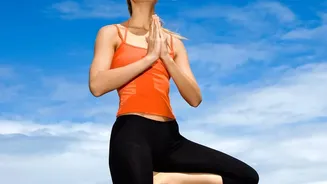
The most critical rule in Tree Pose is to protect your knee. Never place the sole of your lifted foot directly onto the side of your standing knee. The knee joint is not designed to handle sideways pressure, and doing so risks injury. Instead, always position your foot either on the inner calf, below the knee, or on the inner thigh, above the knee. This simple adjustment is the most important step in avoiding strain and building a safe, sustainable practice.
Beginner Variations for Building Stability
If you're new to balancing, start with supportive variations. The goal is to build confidence and strength. A great starting point is the 'kickstand' version: place the ball of your lifted foot on the floor with your heel resting against the inner ankle of your standing leg. This gives you stability while still practicing the hip-opening action of the pose. You can also practice near a wall or a sturdy chair, using it for light touch-support as you build balance. For foot placement, start with your foot on your inner calf. This is a stable and safe position to work on your alignment.
Using Props to Find Your Balance
Yoga props are excellent tools for making poses more accessible. Blocks, in particular, can be very helpful in Tree Pose. If your hips are tight, placing a yoga block between your raised foot and your standing leg can offer support and help maintain proper alignment without strain. A wall is another powerful prop. You can stand with your back against it or just have it nearby for reassurance if you wobble. Using props is not a sign of weakness; it’s a smart way to learn the mechanics of a pose safely.
Intermediate and Advanced Progressions
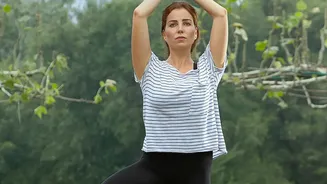
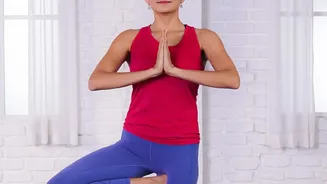
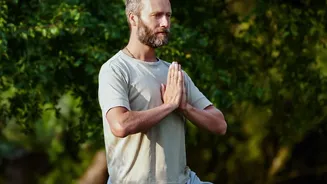
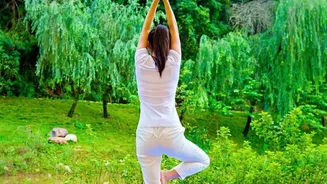
Once you feel stable with your foot on your inner calf or thigh, you can explore other challenges. Try different arm variations: bring your palms together at your heart (Anjali Mudra), or extend them overhead like the branches of a tree. For an advanced hip-opener, you can work toward Half-Lotus Tree Pose (Ardha Padmasana in Vrksasana), where the foot rests on the opposite hip crease. This should only be attempted if you have significant hip and knee flexibility, and never by forcing the joint. To truly test your balance, try closing your eyes for a few seconds. This removes your visual anchor and forces you to rely on your inner stability.
The Core of Balance: Hips and Breath
Proper alignment in Tree Pose is about more than just your legs. Keep your hips level and squared to the front. There is a tendency for the hip of the lifted leg to hike up, which creates misalignment in the spine. Actively press the foot and the standing leg into each other to create a stable, energetic connection. Finally, remember to breathe. Holding your breath creates tension and instability. A steady, calm breath will help steady your body and mind, allowing you to find both strength and ease in the pose.