



More Than Just a Marathon
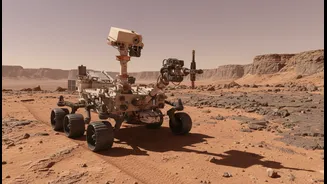
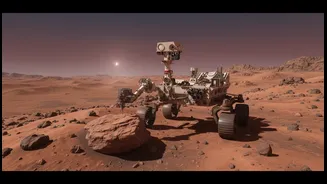
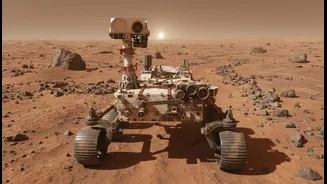
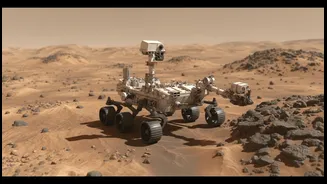
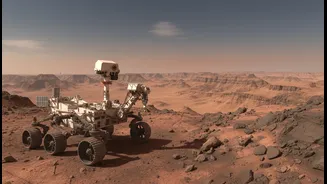
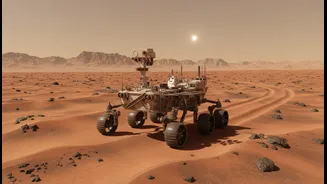
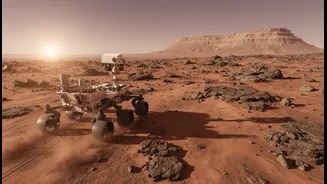
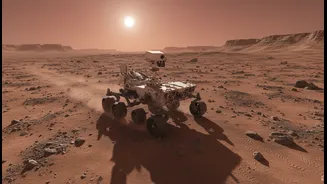
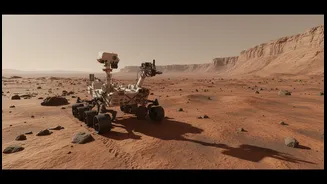
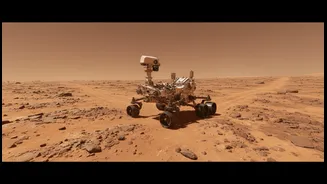
In mid-2026, NASA's Perseverance rover officially crossed a major milestone: it traveled the full 42.195 kilometres of a marathon on the Martian surface. While the achievement is impressive on its own—accomplished in less than half the time it took the Opportunity
rover—the real story is not the distance, but how it was achieved. Perseverance’s journey represents a monumental leap in robotic exploration, transforming the process from a slow, heavily supervised crawl to a fast-paced, semi-independent scientific expedition. This marathon isn't just a record; it's a demonstration of a new philosophy for exploring other worlds, one built on longevity and autonomy.
The Power to Persevere
A key reason for Perseverance's long and productive life is its power source. Unlike the solar-powered Spirit and Opportunity rovers, which were vulnerable to dust storms and the dimming Martian sun, Perseverance runs on a Multi-Mission Radioisotope Thermoelectric Generator, or MMRTG. This nuclear battery uses the heat from the natural decay of plutonium-238 to generate a steady supply of electricity, day and night, for more than a decade. This reliable power source not only keeps the rover's scientific instruments and wheels running but also provides essential heat to protect its sensitive electronics from Mars' frigid temperatures. This constant energy supply is the bedrock of its extended mission, allowing it to operate continuously without hibernating and to traverse terrain that would be too risky for a solar-dependent vehicle.
A Rover That Thinks for Itself
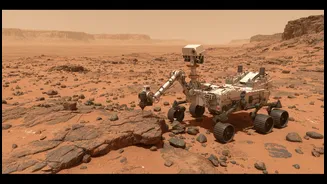
The second pillar of Perseverance’s success is its remarkable independence. Equipped with an advanced autonomous navigation system called AutoNav, the rover can 'think while driving'. While previous rovers like Curiosity had to stop, take images, and wait for analysis before moving, Perseverance can create 3D maps of the terrain ahead, identify hazards like rocks and sand traps, and plot a safe course all while in motion. This has allowed it to set single-day driving records and navigate complex landscapes, like a treacherous, boulder-strewn field, in a fraction of the time it would have taken its predecessors. This self-driving capability dramatically accelerates the pace of exploration, freeing up the mission team on Earth from the painstaking process of micromanaging every single move.
Finding Its Own Way
Until recently, the rover's greatest limitation on a long autonomous drive was its growing uncertainty about its own position. Without a GPS network on Mars, small errors in its location estimate would accumulate, forcing it to stop and wait for confirmation from Earth. But a new technology, Mars Global Localization, has given the rover its own version of GPS. By comparing images from its own cameras with orbital maps stored in its memory, Perseverance can now pinpoint its location to within inches in just a few minutes. This breakthrough, made possible by repurposing a powerful processor originally used to communicate with the Ingenuity helicopter, effectively removes the last major roadblock to long-range autonomous driving. It means the rover can confidently travel farther and faster, unlocking more of the planet for science.
The Blueprint for Future Exploration
Perseverance's mission is about much more than just exploring Jezero Crater. It is a crucial testbed for technologies that will enable the next generation of space exploration, including eventual human missions to Mars. The rover's ability to operate for years, drive autonomously over long distances, and collect scientifically compelling samples for a potential future return to Earth is paving the way for more ambitious ventures. Each kilometre it drives and each decision it makes on its own proves that sophisticated robots can act as effective field geologists millions of miles from home. The lessons learned from this marathon on Mars will inform the design of future rovers sent to the icy moons of Jupiter and Saturn and, ultimately, help ensure the safety and success of the first astronauts to walk on the Red Planet.