





Meet Shukrayaan: India’s Voyage to Venus
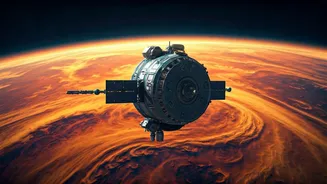
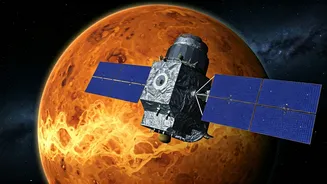
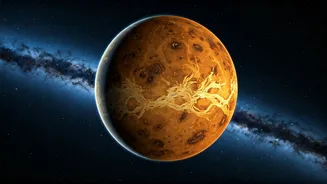
The Indian Space Research Organisation (ISRO) is gearing up for its first-ever mission to Venus, officially named the Venus Orbiter Mission (VOM) and popularly known as Shukrayaan. Following the landmark successes of the Chandrayaan lunar missions and the Mangalyaan
Mars mission, Shukrayaan represents India's next great leap in interplanetary exploration. The Indian government formally approved the mission in September 2024, with a launch planned for March 2028. The spacecraft will be launched aboard the powerful LVM3 rocket and will take several months to enter a stable orbit around Venus. From there, its suite of advanced Indian and international instruments will spend years studying the planet's surface, atmosphere, and interaction with the sun.
Venus: Earth's 'Evil Twin' and a Climate Cautionary Tale
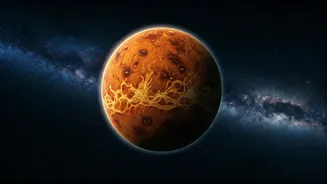
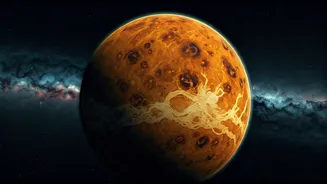
Venus is often called Earth's twin due to its similar size, mass, and composition. However, the similarities end there. Venus is a hellish world with surface temperatures hot enough to melt lead (around 470°C) and a crushing atmosphere more than 90 times denser than Earth's. This hostile environment is the result of a runaway greenhouse effect. Its atmosphere is composed almost entirely of carbon dioxide, which traps heat with terrifying efficiency. Scientists believe Venus may have once been more like Earth, possibly with liquid water oceans. Understanding the processes that transformed it into an inferno provides a natural, albeit extreme, laboratory for studying climate dynamics. It serves as a stark cautionary tale for how dramatically a planet's climate can change.
Unlocking Secrets Above and Below the Clouds
A key reason for scientific excitement is Shukrayaan's powerful toolkit. The mission aims to peer through the dense, toxic clouds of sulfuric acid that perpetually shroud Venus. One of its primary instruments is a high-resolution Synthetic Aperture Radar (SAR), which can map the planet's surface regardless of cloud cover. This will provide unprecedented insights into Venus's geology, including evidence of volcanic activity which plays a major role in its atmospheric composition. Another groundbreaking instrument is a ground-penetrating radar, which will be the first of its kind to study the planet's subsurface. By analysing the layers beneath the surface, scientists can piece together a timeline of the planet's geological and climatic history.
A Data Goldmine for Earth's Climate Models
For climate researchers in India and worldwide, Shukrayaan is not just about exploring another planet; it's about refining our understanding of our own. The data gathered on Venus's atmospheric chemistry, dynamics, and interaction with solar wind is invaluable for testing and improving the climate models used to predict Earth's future. By studying a planet where the greenhouse effect has run rampant, scientists can better understand the tipping points and feedback loops that could accelerate climate change here. The mission will investigate how Venus lost its water and how its atmosphere evolved without a protective magnetic field, providing critical data points that are impossible to obtain on Earth alone. This knowledge strengthens India's scientific capacity to contribute to global climate change solutions.