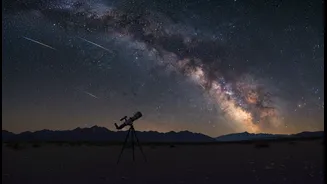








The Dark Sky Advantage
The single biggest obstacle to seeing faint celestial objects is light. This includes city lights and, most significantly, the Moon itself. A new moon occurs when the Moon is positioned between the Earth and the Sun, so its illuminated side faces away
from us, rendering it invisible in our night sky. This month, the new moon falls on July 14, creating the darkest possible conditions. This period, roughly the week before and after the 14th, is the ideal time to hunt for faint objects like nebulae and distant galaxies, which are otherwise washed out by moonlight. Without the Moon’s glare, the sky’s contrast is at its maximum, allowing even subtle glows from millions of light-years away to become visible.
Celestial Jewels on Display
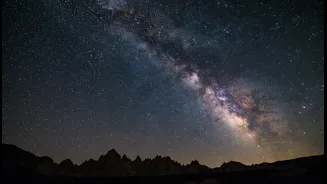
With the moon out of the way, the heart of our own Milky Way galaxy becomes the star of the show. Look towards the southern sky in the constellation Sagittarius, which resembles a teapot. This region is brimming with wonders. Prime targets include the Lagoon Nebula (M8) and the Trifid Nebula (M20). The Lagoon Nebula is a vast stellar nursery where new stars are being born, and it's so large and bright it can be spotted with binoculars as a distinct fuzzy patch, even from the suburbs. Just nearby, the Trifid Nebula is a unique combination of a pink emission nebula, a blue reflection nebula, and dark dust lanes that give it a three-lobed appearance. Higher in the sky, in the constellation Hercules, lies the Great Globular Cluster (M13). This tightly packed ball of hundreds of thousands of ancient stars is one of the brightest of its kind and is another spectacular sight in binoculars.
Navigating the Monsoon Sky
Stargazing in July in India means contending with the monsoon. While persistent cloud cover can be frustrating, it doesn’t make viewing impossible. The key is patience and planning. Use weather apps that specifically show cloud cover forecasts, not just rain predictions. Look for clear patches and be ready to take advantage of them, even if they only last for an hour. Coastal and mountainous areas can experience rapid weather changes, so breaks in the clouds are common. The best strategy is to have your gear ready and your targets in mind. When a gap appears, you won't waste precious minutes deciding what to look for. Don’t be discouraged by a cloudy evening; often, conditions can improve later in the night.
Gear Up for a Glimpse
You don't need an expensive telescope to enjoy this deep-sky window. In fact, a simple pair of binoculars is arguably the best tool for a beginner. Binoculars offer a wide field of view, making it easier to scan the star-rich fields of the Milky Way and locate objects like the Lagoon Nebula and M13. When you find your target, try to hold the binoculars steady or mount them on a tripod to prevent shaking. If you are just using your eyes, find the darkest spot you can, away from direct streetlights and building lights. Allow your eyes at least 20-30 minutes to fully adapt to the dark; this will dramatically increase the number of stars you can see. Avoid looking at your phone screen, as its bright light will instantly ruin your night vision. If you need a light, use a red torch, as red light has the least impact on your dark-adapted eyes.