

A 'New' Star in the Sky
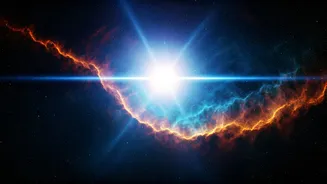
Sometime between now and September 2024, the night sky is set to host a spectacular guest. A star system located 3,000 light-years away, known as T Coronae Borealis, will undergo a dramatic eruption called a nova. For a few precious days, this normally
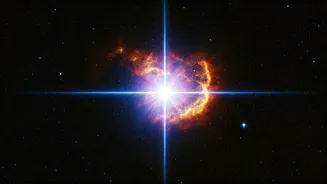
faint star, far too dim to see without a telescope, will flare up to match the brightness of Polaris, the North Star. It will appear as a 'new' star in the heavens, a temporary beacon visible to the naked eye. This isn't just any stellar event; it's a recurrent nova, an explosive encore that happens roughly every 80 years. The last time it graced our skies was in 1946, making this year's appearance a true once-in-a-generation opportunity to witness cosmic fireworks.
The Cosmic Dance of a 'Blaze Star'
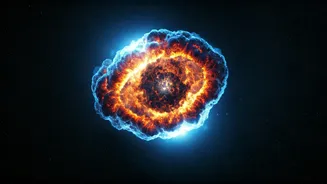
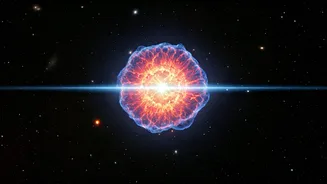
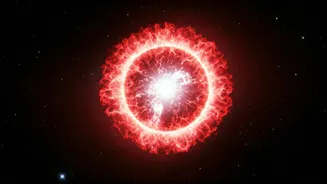
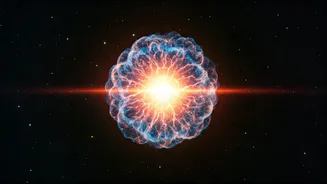
So, what exactly is happening to create this spectacle? T Coronae Borealis isn't a single star but a binary system, a pair of stars locked in a gravitational dance. One is a red giant, a bloated, ageing star, and the other is a white dwarf—the super-dense, collapsed core of a star that was once like our Sun. The white dwarf's immense gravity relentlessly siphons material, mostly hydrogen, from the outer layers of its larger companion. This stolen gas accumulates on the white dwarf's surface, like piling fuel onto a cosmic fire. Over decades, the pressure and temperature build to a critical point. Eventually, it triggers a runaway thermonuclear explosion on the star's surface. This cataclysmic blast ejects a shell of material into space and causes the system to brighten by a factor of thousands, creating the brilliant nova we see from Earth. The star itself survives, and the process of accretion begins all over again, setting the clock for the next eruption decades from now.
A Star with a Storied Past
This isn't the star's first time in the spotlight. Its eruption in 1946 was watched by a generation recovering from World War II. Before that, it was famously observed in 1866 by Irish astronomer John Birmingham, who earned it the nickname 'the Blaze Star'. Each time it appears, it connects us to a different era, reminding us that the sky above is a dynamic, ever-changing theatre. Ancient sky-watchers, without the benefit of modern science, would have seen this sudden point of light and likely woven it into their myths and legends. When we look up at T Coronae Borealis this year, we are sharing an experience with countless generations before us. It’s a powerful link to our shared human history of looking at the cosmos with wonder. This predictability is what makes it so special; unlike a supernova, which marks the death of a star, this is a cycle of cosmic rebirth.
How to See the Historic Flare-Up
The best part about this event is its accessibility. You won't need an expensive telescope or professional equipment. To find it, you’ll need to locate the constellation Corona Borealis, or the 'Northern Crown'. It's a small, semi-circular arc of stars located between the bright stars Vega (in the constellation Lyra) and Arcturus (in Boötes). The constellation is best viewed from the Northern Hemisphere, making it visible from India during the summer months. Once the nova erupts, it will be unmistakable—a bright new point of light within that familiar crown shape. The key will be to act fast. While the lead-up is slow, the eruption's peak brightness will likely only last for a few days before it begins to fade back into obscurity for another 80 years. Stargazing apps on your phone can help you locate the constellation, so you’re ready to look up the moment astronomers announce the show has begun.