



We tend to imagine our solar system as a place of perfect, clockwork precision. But new research suggests this cosmic stability may have an expiration date, with the giant outer planets facing a future far more chaotic than we ever thought.
Recalibrating a Cosmic Clock
For centuries,
we have looked to the heavens for a sense of permanence. While Isaac Newton himself suspected the solar system might one day fall into disarray, modern science has largely painted a picture of long-term stability. Previous models predicted that the outer planets—Jupiter, Saturn, Uranus, and Neptune—would continue their stately dance for tens, if not hundreds, of billions of years after the Sun dies. A recent study, however, dramatically shortens that timeline. Researchers ran hundreds of complex simulations to model the far future, introducing a key factor that was previously overlooked: the way the Sun will lose mass as it ages and dies. Instead of shedding mass smoothly, newer models suggest the Sun will do so in uneven bursts, creating small but significant gravitational 'kicks' that ripple through the system.
The Coming Chaos for the Giants
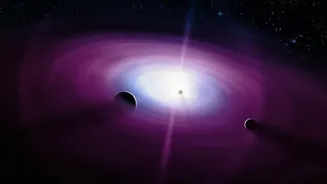
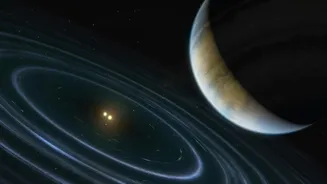
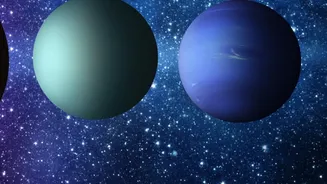
The results of these new simulations point to a violent and unpredictable future for the gas giants. According to the research, published in The Astrophysical Journal Letters, there is a significant chance for major disruption among the outer planets. In about five billion years, our Sun will exhaust its hydrogen fuel and swell into a red giant, eventually collapsing into a white dwarf. The loss of solar mass weakens its gravitational pull, causing the remaining planets' orbits to expand. The unpredictable, jerky nature of this mass loss, however, could throw the whole system into chaos. The simulations showed scenarios where planets developed bizarre, elongated orbits, crossed paths, and even collided with one another. In some cases, Saturn was ejected from the solar system entirely, while Uranus and Neptune were shown to switch places.
The Dance of Resonance and Instability
The key to this instability lies in a concept called 'orbital resonance'. Think of it like pushing a child on a swing; if you push at just the right time in the swing's arc, you add energy and send it higher. In space, when the orbital periods of two planets form a simple ratio (like Neptune completing three orbits for every two of Pluto's), their gravitational pushes can add up over time. This can sometimes be a stabilizing force, locking planets into safe, predictable paths. However, the new study suggests that as the Sun's gravity weakens unevenly, the giant planets could be nudged into new, unstable resonances. These new orbital relationships wouldn't protect the planets but instead amplify their gravitational disturbances, accelerating their march toward disorder and potential collisions.
A Galactic Forecast Billions of Years Away
Before anyone panics, it is crucial to understand the timescale. These dramatic events are not predicted to happen tomorrow, or even in the next few million years. The study focuses on a period beginning around five billion years from now, as the Sun begins its death throes. While previous estimates gave the outer solar system a lifespan of up to 100 billion years or more post-Sun, the new research shortens this to as little as one billion years after our star becomes a white dwarf. In roughly 40% of the most extreme simulations, major disruptions began even earlier, while the Sun was still in its red giant phase. So, while Earth's fate is sealed within the expanding Sun much earlier, the giant planets that survive will face their own dramatic end billions of years later.