






The Forest-Rain Connection
For a long time, the relationship between forests and rain was considered a one-way street: rain helps forests grow. While true, modern science reveals a more complex, two-way relationship. Forests are not just passive recipients of rainfall; they actively
help create it. Through a process called evapotranspiration, trees release vast amounts of moisture into the atmosphere. This moisture adds to the clouds, which then release it as rain, often further inland. This 'recycling' of precipitation is crucial, especially in large countries like India. Some studies suggest that in areas like the Ganga Basin and Northeast India, this recycled component is very high, meaning local forests have a significant impact on local rainfall.
A Monsoon in Flux
The Indian summer monsoon, which delivers about 80% of the country's annual rainfall, is becoming dangerously unpredictable. The predictable pattern of steady rain from June to September is being replaced by prolonged dry spells punctuated by sudden, extreme downpours. Climate models predict that for every degree Celsius of warming, monsoon rainfalls will likely increase by about 5%, but this increase isn't uniform. Instead, it manifests as more extremely wet years and chaotic, volatile patterns that threaten agriculture, water security, and urban infrastructure. This isn't just a future problem; scientists note that human-induced climate change has been the dominant driver of monsoon dynamics since the 1980s.
The Impact of a Disappearing Canopy
This is where forests re-enter the picture. As India has lost forest cover over the past few decades, scientists have observed a direct impact on the monsoon. Deforestation has been linked to a weakening of the summer monsoon and a decline in rainfall. Losing trees reduces the amount of moisture recycled into the atmosphere, which can curtail rainfall, particularly in regions far from the coast. Studies focusing on specific regions like the Western Ghats have found that deforestation there reduces moisture recycling, leading to less rain across the Deccan Plateau, hundreds of kilometres away. It's a vicious cycle: climate change puts stress on forests, and a decline in forest health further destabilizes the climate.
Where Scientists Are Focused
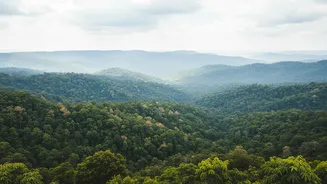
Scientists are paying close attention to India's most ecologically sensitive zones. The Western Ghats and the Himalayas, two of the nation's most vital biodiversity hotspots, are under intense scrutiny. A recent study warned that rising temperatures and erratic rainfall could cause evergreen forests in Tamil Nadu's Western Ghats to shrink by 2050, while drier thorn forests expand. In Central India, a study of the Panchmarhi Biosphere Reserve found it lost about 13% of its forest cover between 1972 and 2020, driven by both human pressure and climate shifts that increase fire risk. These regions are like canaries in the coal mine, providing early warnings about how ecosystems will transform under continued stress.
More Than Just Trees at Stake
The consequences of this destabilization are far-reaching. For a nation where agriculture is highly dependent on predictable rains, volatile monsoons are a direct threat to the food system and economy. Too much rain at the wrong time can be just as damaging to crops as a drought. Furthermore, weakening forests are less effective at absorbing carbon, a phenomenon already being observed. A 2025 study from IIT Kharagpur noted that even as India's green cover has reportedly increased, the health of its forests is declining, with their ability to absorb carbon dropping under the stress of a warming, drying climate. This decline in health also leads to what scientists call “ecological droughts,” long-term moisture stress that damages entire ecosystems, from pristine forests to croplands.