





The Cosmic 'Missing Link'
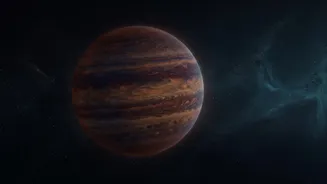
Imagine an object that forms like a star from a collapsing cloud of gas and dust but never quite makes it. That’s a brown dwarf. These celestial bodies are more massive than planets but lack the sheer heft—roughly 80 times the mass of Jupiter—needed to
ignite and sustain the hydrogen fusion that powers a star like our sun. Because they don't shine brightly, they are incredibly difficult to find and study. Often called 'failed stars', they are more like cosmic embers, slowly cooling and fading over time. This makes them a fascinating 'missing link' between the largest gas giants and the smallest stars, holding clues about how both are born.
Enter SPHEREx: The All-Sky Surveyor
Enter NASA's Spectro-Photometer for the History of the Universe, Epoch of Reionization, and Ices Explorer, or SPHEREx. Launched in 2025, this space observatory is designed to conduct a rapid survey of the entire sky, creating a comprehensive map not just in one or two colours of light, but in 102 different bands of near-infrared light. While its primary goals are to study the early universe and the origins of galaxies, its unique capabilities make it a perfect tool for a side project: hunting brown dwarfs. Unlike targeted telescopes like the James Webb, which zoom in on specific objects, SPHEREx's mission is to scan everything, mapping hundreds of millions of galaxies and stars multiple times over its two-year mission.
Why Infrared Vision is Key
The secret to finding these dim objects lies in SPHEREx's vision. Brown dwarfs are cool by stellar standards, meaning they don't emit much visible light. Instead, they glow faintly in infrared, a wavelength of light that is invisible to the human eye. From its vantage point in space, SPHEREx can detect this faint infrared glow without interference from Earth's atmosphere, which absorbs many of these critical wavelengths. By capturing the entire sky in so many infrared colours, the telescope can spot the tell-tale signatures of these cool, dim objects scattered across our galaxy, turning what was once a search for a needle in a haystack into a systematic survey.
Decoding a Brown Dwarf's Atmosphere
Finding brown dwarfs is only the first step; understanding them is the real prize. SPHEREx uses a technique called spectroscopy, which splits light into its component wavelengths, much like a prism creates a rainbow. This creates a chemical 'fingerprint' for each object, revealing the molecules present in its atmosphere. Recent findings from SPHEREx have shown that brown dwarf atmospheres are chemically rich, containing molecules like methane, carbon dioxide, and carbon monoxide. These observations are crucial for testing and refining theoretical models about how these objects' atmospheres and exotic clouds behave as they cool over billions of years. Scientists have already analyzed dozens of brown dwarfs with SPHEREx data and have thousands more to examine.
From a Few Dozen to Thousands
Before SPHEREx, astronomers had studied only a few dozen brown dwarfs in detail with space-based telescopes. The mission is set to increase the number of brown dwarfs with detailed infrared spectra by a factor of 100, providing an unprecedented catalog for the entire scientific community. This vast dataset will not only help scientists understand the variety and life cycle of these 'goth' celestial objects but also provide crucial information about star and planet formation. By charting the abundance of these objects, their temperatures, and their compositions, SPHEREx is providing a new window into a previously murky corner of our cosmos.