



A Landmark Discovery in a Distant Sky
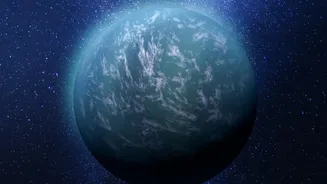
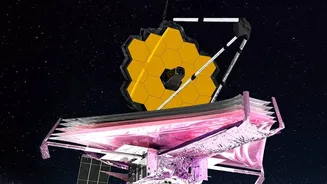
In a breakthrough for astronomy, the JWST has identified a rich cocktail of carbon-based molecules in the atmosphere of a rocky exoplanet hundreds of light-years away. While finding simple gases like carbon dioxide is becoming more common, this finding is different.
The telescope detected signs of more complex hydrocarbons like ethane, molecules with multiple carbon atoms bonded together. This is significant because it's the first time such 'heavy' carbon gases have been clearly identified on a world with a solid, rocky surface like Earth's, moving the conversation beyond the gas giants where such chemistry is more expected.
Why Carbon Is a Cosmic Clue
Carbon is the backbone of life as we know it, forming the complex chains that create everything from amino acids to DNA. Finding it in any form on a distant planet is exciting. Methane, a simple molecule with one carbon atom, has often been a focus in the search for biosignatures—signs of life. Its presence can be tantalizing because, on Earth, a huge amount of it is produced by living organisms. However, methane can also be produced by purely geological processes, making it an ambiguous signal on its own. The discovery of heavier carbon molecules adds a fascinating new layer to this puzzle.
More Than Just Simple Gas
The jump from methane (one carbon atom) to ethane (two carbon atoms) and other more complex hydrocarbons is a significant one. It suggests a chemical environment that is rich and active enough to build more complicated molecules. While this doesn't automatically mean life, it points to a planetary system with a robust inventory of the chemical building blocks necessary for it. Scientists are excited because this type of carbon-rich environment around a rocky world was previously only theoretical. The latest observations show that the chemical 'menu' on these planets can be profoundly different from what we see around sun-like stars, potentially leading to different kinds of planetary atmospheres.
A Planet's Geological Pulse
So, if it's not aliens, what could be producing these heavy gases? The leading hypothesis points to a geologically active world. Think of large-scale volcanic activity or outgassing from a molten interior, processes that can churn up materials from deep within the planet and release them into the atmosphere. On some super-hot exoplanets, scientists have found evidence of atmospheres above what they believe are global magma oceans. The presence of complex carbon gases could be a sign of similar, though perhaps less extreme, geological processes that replenish an atmosphere over millions of years. A geologically 'alive' planet is considered more likely to be habitable than a dead, inactive one.
How the Webb Telescope Plays Detective
The JWST achieves these remarkable feats using a technique called spectroscopy. When a planet passes in front of its star from our perspective, a tiny fraction of the starlight filters through the planet's atmosphere. Different gases in that atmosphere absorb specific colours, or wavelengths, of light. By analysing the starlight that reaches the telescope, astronomers can see which colours are missing and deduce exactly which molecules are present, how much there is, and even the temperature and pressure of the atmosphere. It is this incredible sensitivity that has allowed JWST to move beyond detecting just water or carbon dioxide to identifying a wider range of molecules on rocky worlds.
A New Chapter in the Search for Life
This discovery does not confirm the existence of life elsewhere. What it does, however, is prove that we have the technology to find the kinds of complex molecules that are considered precursors to life. It shows that rocky planets can have atmospheres rich in the very elements that are fundamental to biology on Earth. Each detection helps scientists refine what to look for and which planets to prioritise for further study. It’s a critical step in moving from simply cataloguing exoplanets to truly characterising them and understanding their potential to host life. The search is no longer just for another 'pale blue dot,' but for a world with a complex and active chemical story to tell.