



The Fiery Enigma
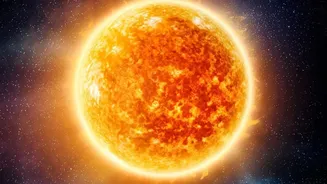
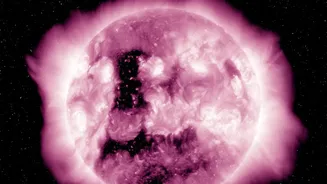
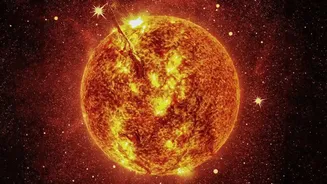
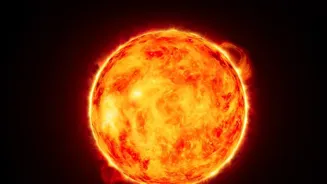
For over 75 years, astronomers have been puzzled by the coronal heating problem. Logic suggests that as you move away from a heat source, the temperature should drop. Yet, the Sun’s wispy outer atmosphere, or corona, is hundreds of times hotter than the fiery
surface below it. This defiance of basic physics has been a central mystery in astrophysics, prompting a decades-long search for a hidden mechanism that is superheating the corona. Scientists have long believed the answer lies in the Sun's complex magnetic fields, which dominate the corona and act as conduits for energy, but the exact process has remained elusive. Two main theories have competed: one involving countless tiny explosions called 'nanoflares' and another involving the dissipation of magnetic waves.
A Wave Predicted, Finally Seen
Recent groundbreaking observations may have just provided the smoking gun for the wave theory. Using the world's most powerful solar telescope, the Daniel K. Inouye Solar Telescope in Hawaii, scientists have for the first time directly observed small-scale, twisting magnetic waves in the corona. These specific motions, known as torsional Alfvén waves, were first predicted in 1942 by Nobel laureate Hannes Alfvén but had never been conclusively identified on this scale. While larger versions of Alfvén waves have been spotted before, often related to massive solar flares, this is the first time the constant, smaller, twisting variety has been seen. Researchers believe these ever-present waves could be the missing energy source that powers the corona's extreme heat.
How Twisting Heats an Atmosphere
Imagine grabbing a stretched-out rubber band and twisting it back and forth. That twisting motion carries energy along the band. Torsional Alfvén waves work in a similar way, but on a cosmic scale. They are twisting motions that travel along the Sun's magnetic field lines, which act like massive cosmic strings. These waves are generated by the churning, convective motions on the Sun's surface. As they travel upwards into the much less dense corona, their energy can be dissipated as heat, much like friction warms your hands when you rub them together. The new observations show these waves are not rare events, but a constant feature, suggesting they could provide a steady, reliable source of heat to the entire corona.
A New Era of Solar Observation
This breakthrough was made possible by incredible new technology. The Inouye Solar Telescope's advanced instrument, the Cryogenic Near-Infrared Spectropolarimeter (Cryo-NIRSP), allowed researchers to see incredibly fine details and measure the subtle Doppler shifts—tiny changes in light caused by motion—in the corona's plasma. This allowed them to detect the opposing red and blue shifts on either side of thin magnetic loops, the tell-tale signature of a twisting motion. This discovery complements findings from missions like NASA’s Parker Solar Probe and the European Space Agency's Solar Orbiter, which fly through the corona and measure particles and fields directly. Together, these tools are giving us a comprehensive new view of our star.
Solving the Puzzle, Piece by Piece
While the discovery of these torsional waves is a giant leap forward, it doesn't mean the coronal heating puzzle is completely solved just yet. The Sun's atmosphere is incredibly complex, and it's likely that multiple mechanisms are at play. For instance, another process called magnetic reconnection, which drives explosive solar flares, also contributes to heating. Scientists now face the task of figuring out just how much energy these newly-seen waves carry and what percentage of the corona's total heat they can account for. Future observations will aim to refine these measurements and integrate them into our models of space weather, which is driven by the very coronal heating that affects satellites and power grids here on Earth.