

A New Eye on the Early Universe
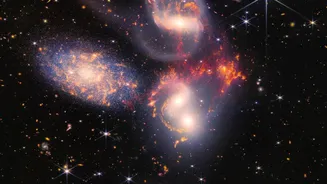
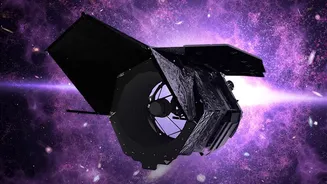
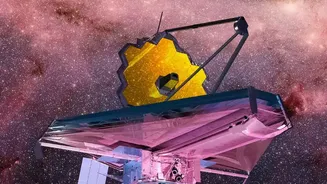
The revolution in our understanding is being driven by the unparalleled power of the James Webb Space Telescope (JWST). Launched to peer deeper into space and further back in time than any instrument before it, Webb is specifically designed to capture
the faint, infrared light from the universe's dawn. This allows astronomers to see the very first galaxies as they were forming just a few hundred million years after the Big Bang, an era previously shrouded in mystery. For years, our story of the cosmos followed a clear script based on the standard model of cosmology: after the Big Bang 13.8 billion years ago, gravity slowly gathered clouds of gas, which ignited the first stars and gradually assembled into small, chaotic galaxies. Webb's mission was to find evidence of this process. Instead, it found something far more puzzling.
Galaxies Too Mature, Too Soon
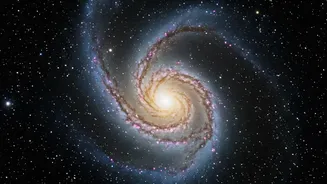
The central surprise from JWST’s deep-field observations is the discovery of galaxies that appear far too massive, bright, and well-structured for their age. According to prevailing theories, galaxies in the cosmic dawn should have been small and messy, still in the chaotic process of formation. Yet Webb is consistently finding galaxies that look surprisingly mature. Some appear to have already ceased forming stars, a process known as 'quenching' that was thought to take billions of years. Finding these massive, quenched galaxies so early in cosmic history is a major challenge. One such galaxy, ZF-UDS-7329, had already stopped making stars just two billion years after the Big Bang, far sooner than models predicted. This suggests that the processes of galaxy formation and shutdown were happening much faster and more efficiently than anyone anticipated.
Challenging the Standard Model
These findings are putting real pressure on the Lambda-CDM model, the standard framework for understanding the universe's evolution. The model, which assumes the universe is broadly uniform and consists of regular matter, dark matter, and dark energy, has been incredibly successful. However, it struggles to account for these 'impossible' early galaxies. For instance, astronomers recently found an extremely massive early galaxy that, surprisingly, showed no evidence of rotation. This is a characteristic usually seen in modern, highly evolved galaxies that have undergone multiple mergers over billions of years, not in a young one. The presence of such advanced structures, along with the unexpected brightness and chemical maturity of other distant galaxies, suggests that our foundational assumptions about how fast structures can form might be incomplete.
A New Chapter in Cosmic Origins
So, what does this all mean for the history of the universe? It doesn't mean the Big Bang is wrong, but it does signal that the first chapters unfolded differently than we thought. The early universe appears to have been far more efficient at building large, complex structures than our models allowed. Scientists are now exploring new ideas to explain this rapid development. Perhaps the first generation of stars formed and died much faster, seeding the cosmos with heavy elements earlier than expected. Or maybe the nature of dark matter itself needs re-evaluation, as some studies suggest it might behave in ways not accounted for in the standard model. Each new image from Webb isn't just a pretty picture; it's a new clue in a cosmic detective story that is actively being rewritten. The telescope is not just confirming old theories; it is forcing astronomers to ask more profound questions about the very nature of cosmic evolution.