







The New Teacher's Assistant in Town
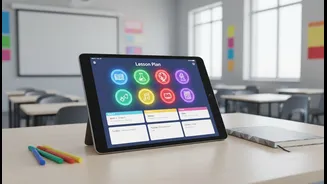
Imagine a teaching assistant that never sleeps, can draft a week's worth of lesson outlines in minutes, and suggests activities tailored to different learning styles. This is the reality offered by a growing number of AI lesson planning tools. Platforms
like MagicSchool, Diffit, and Eduaide.AI are designed to streamline the administrative burdens of teaching. By inputting a topic, grade level, and learning objectives, educators can generate structured lesson plans, activity ideas, and even assessment questions almost instantly. This automation of routine tasks is a significant time-saver, freeing teachers from hours of paperwork to focus on what truly matters: their students. The adoption of these technologies is part of a broader push, with government initiatives like the National Education Policy (NEP) 2020 emphasizing the integration of AI in education to boost efficiency and skills.
Forging Consistency Across Classrooms
One of the greatest challenges in a large and diverse education system like India's is ensuring consistency. AI tools can be a powerful ally in this regard. They help teachers align lessons with curriculum standards, such as those set by CBSE, ensuring that all students are exposed to the core concepts required for their grade level. This creates a standardized foundation, which is crucial for maintaining educational quality across different schools and regions. For school administrators, it offers a way to ensure that learning objectives are being met consistently, while for teachers, it removes the guesswork involved in curriculum mapping. The tools can generate plans that follow a logical flow, ensuring that complex topics are broken down and taught systematically.
A Launchpad for Deeper Creativity
A common fear is that AI will stifle teacher creativity, producing generic, cookie-cutter lessons. However, many educators are finding the opposite to be true. By handling the repetitive, structural parts of planning, AI tools liberate teachers to invest their time and mental energy in the more creative aspects of their job. Instead of spending hours formatting a plan or finding standard-aligned resources, a teacher can use that time to design a more engaging project, develop interactive activities, or provide one-on-one support to a struggling student. The AI-generated plan serves as a starting point or a scaffold, not a rigid script. Teachers can brainstorm ideas with the AI, ask for fresh perspectives on a topic, and then use their professional judgment to adapt, refine, and personalise the content to fit their classroom's unique personality and needs.
Navigating the Potential Pitfalls
Despite the benefits, the use of AI in education is not without its challenges. A significant concern is the risk of over-reliance on these tools, which could lead to a decline in critical thinking and lesson planning skills among educators. AI-generated content can sometimes be superficial, inaccurate, or lack the nuanced understanding of a specific classroom's context. There are also valid concerns around data privacy and algorithmic bias, where AI systems might perpetuate existing stereotypes or prove inequitable for certain student groups, such as non-native English speakers. For these tools to be effective, educators must treat them as a co-pilot, always verifying the information and using their own expertise to make the final instructional decisions.
The Irreplaceable Human Element
Ultimately, AI is a tool, not a replacement for a teacher. It cannot replicate the empathy, emotional connection, and real-time responsiveness of a human educator. AI can't get to know a student's interests, understand the cultural context of the classroom, or build the trusting relationships that are fundamental to learning. In the Indian context, where classrooms are diverse and multilingual, the teacher's ability to connect with students on a personal level is paramount. The true power of these AI planners is realised when they are used to augment a teacher's skills, handling the administrative load so the educator can focus on the deeply human and creative work of inspiring young minds. The goal is not to automate teaching, but to empower teachers.