




What Exactly is a VR Classroom?
Imagine stepping not into a room with desks and a blackboard, but into a laboratory where you can shrink to the size of an atom or stand on the surface of Mars. This is the promise of the AI VR classroom. At its core, it’s a learning environment that
uses a Virtual Reality (VR) headset to transport students into a fully simulated, three-dimensional world. Here, abstract scientific principles are no longer just equations on a page; they become interactive phenomena. Students can physically ‘hold’ a molecule, conduct a risky chemical reaction without any danger, or travel alongside a light beam to understand relativity. It’s the ultimate ‘show, don’t tell’ approach to education, designed to build intuitive understanding by letting you experience the concepts firsthand.
Making the Impossible, Possible
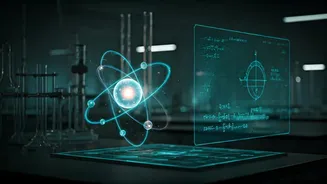
For generations, teaching advanced physics has relied on analogies and thought experiments. How do you truly explain the bizarre world of quantum mechanics or the warping of spacetime near a black hole? This is where immersive simulation becomes a superpower. In a VR physics lab, a student can directly observe the wavelike and particle-like behaviour of an electron in a simulated double-slit experiment, something impossible to see in a real-world lab. They can adjust the mass of a planet and watch how its gravitational pull affects nearby moons, providing a gut-level feel for concepts that are otherwise purely mathematical. This active participation, rather than passive observation, has been shown to dramatically increase engagement and retention, turning a subject many find intimidating into a captivating exploration.
The ‘AI’ That Powers the Experience
The VR headset provides the world, but the Artificial Intelligence (AI) makes it smart. The ‘AI’ in these classrooms acts as a dynamic, personalised tutor for every student. As a student conducts an experiment, the AI can analyse their actions, provide real-time feedback, and subtly guide them toward a discovery. If a student is struggling with a particular concept, the AI can adapt the simulation, offering simpler examples or highlighting key variables. It can generate new problems, ask Socratic questions to prompt critical thinking, and track a student's progress to identify knowledge gaps. This creates a bespoke learning path for everyone in the class, ensuring that no one gets left behind and those who are ahead remain challenged. The AI transforms the simulation from a static environment into a responsive, intelligent educational partner.
The Indian Context: A Leap for STEM Education?
For a country like India, with a strong focus on STEM (Science, Technology, Engineering, and Mathematics), this technology holds immense potential. High-quality physical laboratories are expensive and not uniformly accessible across all schools, especially in remote areas. A VR lab, once the initial hardware investment is made, can offer millions of students access to world-class experimental facilities. Recognizing this, major players are already making inroads. For instance, Meta has partnered with the Central Board of Secondary Education (CBSE) to train educators and students in AR and VR technologies, aiming to integrate them into the curriculum. While still in its early days, these initiatives signal a future where a student in a small town could have the same access to advanced physics simulations as someone in a top-tier metropolitan institution, levelling the educational playing field.
Challenges on the Road Ahead
Despite the excitement, widespread adoption faces significant hurdles. The most obvious is cost. High-quality VR headsets and the powerful computers needed to run them are not cheap. Furthermore, there's the challenge of creating a rich library of high-quality, pedagogically sound content. A cool simulation is not enough; it needs to be integrated into a curriculum by trained teachers. Educator training is paramount, as instructors must shift from being lecturers to facilitators of discovery within these virtual worlds. Finally, issues like digital equity, internet connectivity, and even the physical discomfort some users experience with VR (cybersickness) must be addressed before these immersive classrooms can become a mainstream reality.