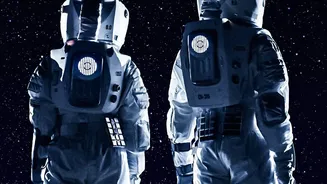







The Challenge of Moonwalking
Exploring the Moon is far more physically demanding than the old footage suggests. The Apollo-era space suits, while masterpieces of their time, were incredibly restrictive. They were designed primarily to keep an astronaut alive in the vacuum of space.
Mobility was a secondary concern. Astronauts struggled with a limited range of motion, making it difficult to bend over, kneel, or even walk naturally. The stiff, balloon-like nature of the pressurized suits forced them into a clumsy, forward-leaning gait to maintain balance. This not only consumed precious time and energy but also limited the scope of scientific work they could perform. Picking up a rock, for instance, became a major chore. For the upcoming Artemis missions, which will target the scientifically rich but treacherous terrain of the Moon's South Pole, a simple hop just won't do.
Introducing the AxEMU
To meet the demands of modern lunar exploration, NASA has partnered with a commercial company, Axiom Space, to develop the next-generation Axiom Extravehicular Mobility Unit, or AxEMU. This is not just an update; it is a complete reimagining of what a planetary space suit can be. Built upon years of NASA's own research, the AxEMU is designed from the ground up to provide a superior range of motion, enhanced safety, and a better fit for a wider variety of astronaut body types. Unlike the custom-tailored suits of the Apollo era, the new suits are modular and adjustable, able to accommodate at least 90 percent of the US male and female population. This ensures that more people than ever before will have the opportunity to walk on the Moon.
Engineered for Unprecedented Flexibility
The secret to the AxEMU's improved mobility lies in its innovative joint design. By combining both soft and hard joint components, the suit allows for movement that was impossible in previous models. Astronauts testing the suit have demonstrated the ability to walk more naturally, squat, kneel, and even lunge. This newfound flexibility is concentrated in the lower torso and legs, critical areas for navigating uneven ground. Imagine being able to bend down and pick up a lunar sample as if you were working in a garden on Earth; that is the goal. The suit also features advanced materials and a partnership with Italian fashion house Prada to optimize the outer layers for the harsh lunar environment, providing protection from extreme temperatures and abrasive moon dust.
Why Better Movement Enables Better Science
Greater flexibility is about more than just astronaut comfort; it directly translates to better science. The Artemis missions aim to conduct complex geological surveys and search for water ice in permanently shadowed craters near the lunar South Pole. This requires astronauts to venture into rugged areas, climb slopes, and use specialized tools to collect samples. The AxEMU's mobility will allow them to perform these intricate tasks more efficiently and safely. Astronauts will be able to cover more ground, investigate more diverse geological features, and set up complex scientific instruments without fighting against their own suits. This enhancement is a critical enabler for NASA's long-term goal of establishing a sustainable human presence on the Moon and preparing for future missions to Mars.